
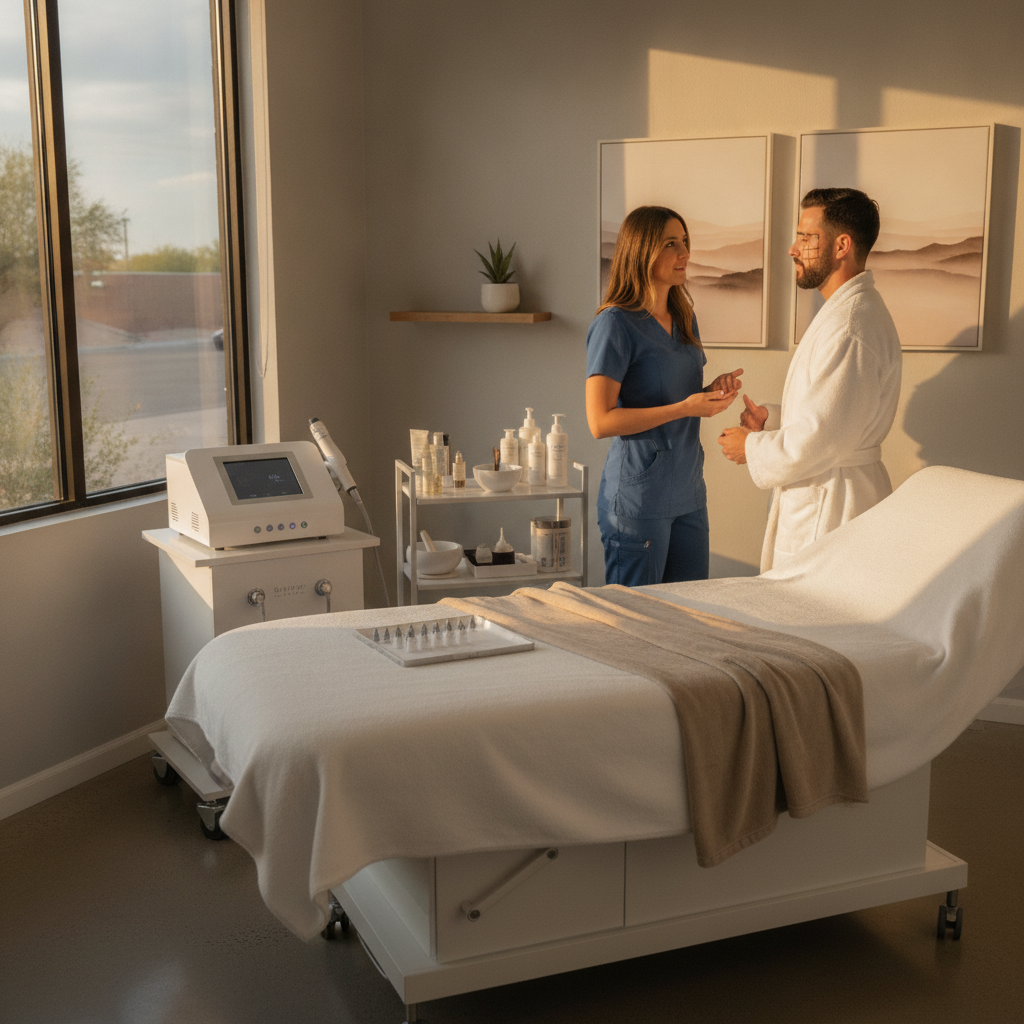
RF microneedling vs. regular microneedling in Mesa — what’s actually the difference, and does it matter for your skin goals? The short answer is yes, it matters quite a bit. Traditional microneedling creates controlled micro-injuries to stimulate your skin’s natural collagen response. RF microneedling does the same thing — but adds radiofrequency energy delivered directly through those micro-channels, heating the deeper layers of skin in a way that standard needling simply can’t reach. The result is a treatment that addresses surface texture and deeper structural laxity at the same time. For men and women in Mesa and the surrounding East Valley who are dealing with acne scars, fine lines, uneven texture, or mild skin sagging, understanding this distinction can make a real difference in choosing the right treatment.
How Traditional Microneedling Works — and Where It Has Limits
Standard microneedling uses a device with fine needles to create thousands of tiny punctures across the skin’s surface. This controlled trauma signals your body to produce collagen and elastin — the proteins responsible for firm, smooth-looking skin. It’s an effective treatment for mild texture concerns, early fine lines, and light scarring, and it has a relatively straightforward recovery.
The limitation is depth. Traditional microneedling primarily works in the epidermis and upper dermis. For skin concerns that originate deeper — like moderate acne scarring, skin laxity after weight changes, or the kind of textural irregularities that come from years of Arizona sun exposure — the surface-level stimulus may not be enough to drive the results you’re hoping for. That’s not a knock on the treatment; it’s just a matter of matching the tool to the problem.
What RF Microneedling Adds to the Equation
Radiofrequency microneedling takes the same foundational approach and pairs it with RF energy delivered at a precise depth through the needle tips. As the needles penetrate the skin, they simultaneously emit heat energy that contracts existing collagen fibers and stimulates a deeper, more robust regenerative response. This dual-action mechanism is why RF microneedling tends to produce more noticeable improvements in skin tightness and scar remodeling compared to traditional needling alone.
Because the RF energy is delivered internally — below the skin’s surface — there’s actually less thermal damage to the outer layers than you’d experience with some resurfacing lasers. That makes it a good option for a wider range of skin tones and types, which is worth noting if you’ve been told in the past that certain energy treatments weren’t right for your complexion.
At Az Laser Studio & Medspa, RF microneedling is used to address a range of concerns — fine lines, acne scars, enlarged pores, uneven skin texture, and mild skin laxity — and it’s often recommended as part of a broader treatment plan depending on what your skin actually needs.
Who Is a Good Candidate for RF Microneedling in the East Valley?
RF microneedling tends to work well for men and women who are:
- Dealing with acne scars — especially the depressed, pitted type (atrophic scarring) — that haven’t responded well to topicals or lighter treatments
- Noticing early to moderate skin laxity, particularly around the cheeks, jawline, or neck
- Frustrated with enlarged pores or rough texture that persists despite a solid skincare routine
- Looking for a non-surgical option after significant weight loss (including GLP-1-related changes) left them with looser skin
- Wanting to address sun damage and uneven tone without the longer downtime of ablative laser resurfacing
It’s also a popular treatment for men in Mesa and Gilbert who want real results with minimal visible recovery — the redness and sensitivity typically resolve within a few days, making it easier to work around a normal schedule.
A few groups aren’t ideal candidates: people with active acne breakouts, certain skin infections, or specific medical conditions should discuss their history at a consultation before moving forward. A provider who skips that step isn’t doing their job thoroughly.
What to Expect: Sessions, Results, and Realistic Timelines
Most RF microneedling plans involve three to four sessions spaced about four to six weeks apart, though this varies depending on your specific skin concerns and goals. A single session isn’t going to deliver dramatic results — the mechanism here is biological, meaning your body needs time to produce new collagen after each treatment. The visible improvements build gradually over two to three months following your final session.
The day of your appointment, a topical numbing cream is applied before treatment begins, which significantly reduces discomfort. The procedure itself typically takes 30 to 60 minutes depending on the area being treated. Immediately after, you can expect some redness and minor swelling — similar to a mild sunburn — that usually settles within 24 to 72 hours. Sun exposure directly after treatment is something to avoid, which is worth planning around if you spend a lot of time outdoors in the East Valley heat.
Speaking of which: the Arizona climate actually makes fall and winter ideal timing for RF microneedling. When UV exposure is slightly more manageable and you’re spending less time outdoors, your skin can recover more comfortably and you can protect the investment you’ve made in your results.
The One Thing Most Competitors Don’t Explain Clearly: RF Depth and Energy Control
One thing that’s often glossed over when competitors describe RF microneedling is that not all devices are the same — and the ability to control needle depth and RF energy intensity matters significantly for both safety and outcome. Adjustable depth settings allow a skilled provider to customize treatment based on the area of the face (thinner skin around the eyes requires different settings than the cheeks, for example) and your specific concern.
This is exactly why provider experience and credentials matter just as much as the technology itself. At a medical spa with physician oversight, your treatment parameters are set based on a real assessment of your skin — not a one-size-fits-all protocol. If you’re comparing providers across Mesa, Chandler, or Gilbert, it’s worth asking directly who performs the treatment, what device they use, and whether a medical director reviews your care plan.
For a full picture of what the medical team at Az Laser Studio & Medspa looks like, visit the about page to learn more about credentials and oversight.
How RF Microneedling Compares to Other Popular Treatments
Patients often ask how RF microneedling stacks up against options like CoolPeel laser resurfacing, IPL, or body contouring with RF. Here’s a quick way to think about it:
- RF microneedling vs. CoolPeel: CoolPeel is an ablative CO2 laser that resurfaces the skin’s surface more aggressively — great for sun damage, fine lines, and pigmentation, but with more visible downtime. RF microneedling works deeper with less surface disruption, making it better suited for laxity and scarring.
- RF microneedling vs. IPL: IPL targets pigment and vascular concerns (sun spots, redness, broken capillaries) but doesn’t address texture or tightness. They work on different skin issues and are often used together as part of a broader plan.
- RF microneedling vs. body contouring RF: NuEra RF body contouring uses radiofrequency technology applied externally to larger treatment areas for fat reduction and cellulite improvement. RF microneedling is specifically designed for facial and surface skin concerns.
If you’re not sure which combination of treatments makes sense for your goals, a consultation is genuinely the best starting point — not a quiz on a website.
Frequently Asked Questions About RF Microneedling in Mesa and Gilbert
Is RF microneedling painful?
Most people describe it as a warm, prickling sensation at most. Topical numbing cream is applied beforehand, and most clients find the procedure quite tolerable by the time treatment begins.
How many sessions will I need?
Most treatment plans call for three to four sessions spaced four to six weeks apart. The number depends on your specific skin concerns — deeper scarring or more significant laxity typically benefits from the full series.
Can RF microneedling be done on any skin tone?
RF microneedling is generally considered safe across a broader range of skin tones than some laser treatments, because the RF energy is delivered below the skin’s surface rather than targeting surface pigment. Your provider should still assess your skin during a consultation.
When will I see results?
Some texture improvements may be visible within a few weeks of your first session, but the most noticeable results build over two to three months after completing your series, as collagen remodeling continues.
Can RF microneedling be combined with other treatments?
Yes — and it often is. At Az Laser Studio & Medspa, RF microneedling is frequently part of a customized treatment plan that might include neurotoxins, fillers, or other skin treatments depending on what your skin needs. Your provider will walk you through what makes sense for your specific goals at the time of your consultation.
Ready to Learn Whether RF Microneedling Is Right for You?
If you’re in Mesa, Gilbert, Chandler, or anywhere across the East Valley and you’ve been curious about RF microneedling — whether it’s right for your skin type, what results are realistic, or how it fits with other treatments you’re considering — the best next step is a real conversation with a provider who can actually look at your skin. Az Laser Studio & Medspa offers complimentary consultations so you can get clear, honest answers before committing to anything. Reach out today to schedule yours.