
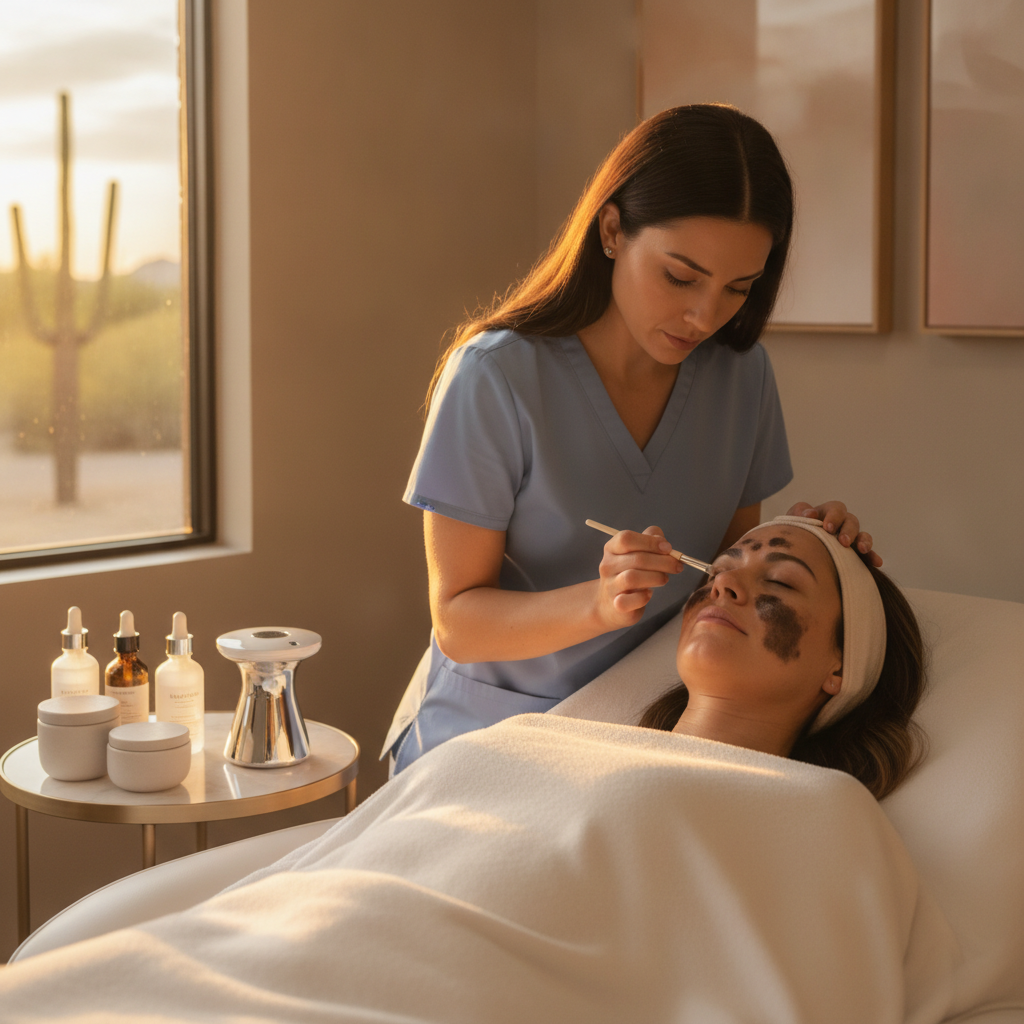
What Is Medspa Treatment for Hyperpigmentation — and What Actually Works for Dark Spots and Uneven Skin Tone in Gilbert and Mesa?
If you’ve been dealing with dark spots, blotchy skin tone, or stubborn patches that won’t respond to your skincare routine, you’re far from alone — and you’re in one of the toughest climates in the country for it. Hyperpigmentation is one of the most common concerns we hear from clients across Gilbert, Mesa, and the broader East Valley, and it’s also one of the most frequently mismanaged. The good news: when it’s properly diagnosed and treated with the right combination of professional tools, real improvement is absolutely achievable. The key is understanding that not all dark spots are created equal — and that what works for one type can actually make another worse.
Why Hyperpigmentation Is Such a Big Issue in the East Valley
Living in the greater Phoenix metro area means more sun exposure than almost anywhere else in the United States — and that’s year-round, not just in summer. Even in the cooler months when snowbird visitors are filling up medspa appointment books, the UV index here stays high. For residents in sun-soaked communities like Gilbert, Queen Creek, and east Mesa, cumulative sun damage builds up over years, often showing up as brown spots, uneven tone, and a general dullness that over-the-counter brightening creams struggle to touch.
Add to that the fact that many people here spend a lot of time outdoors — hiking, sporting events, backyard living — and it’s easy to see why hyperpigmentation is such a persistent issue in this region. Melasma, in particular, tends to be aggravated by both UV exposure and heat, which makes Arizona’s climate especially challenging for people prone to it.
The Three Types of Hyperpigmentation — and Why the Difference Matters
One area where competitor medspa websites in the East Valley tend to fall short is actually explaining the different types of hyperpigmentation and why they respond to treatment differently. Most sites mention “dark spots” and list a few services, but don’t help you understand what you’re actually dealing with. Here’s a practical breakdown:
Sun Damage and Age Spots
These are the classic brown spots that appear on the cheeks, forehead, hands, and chest after years of UV exposure. They’re generally more superficial and respond well to laser and light-based treatments. If your dark spots have been building up gradually and are fairly well-defined, this category likely applies to you.
Melasma
Melasma presents as larger, often symmetrical patches — typically across the cheeks, upper lip, and forehead. It’s strongly linked to hormonal changes (pregnancy, birth control, and hormone shifts are common triggers) and is notoriously heat-sensitive. Melasma requires a more cautious treatment approach because aggressive laser settings can actually trigger a rebound and make it darker. This is a case where a knowledgeable provider makes all the difference.
Post-Inflammatory Hyperpigmentation (PIH)
PIH is the dark discoloration left behind after a breakout, injury, or skin irritation. It’s especially common in people with medium to deeper skin tones. Treatment here often involves a combination of gentle exfoliation, topical support, and carefully selected energy-based treatments — with a strong emphasis on not over-treating.
What Medspa Treatments Actually Address Hyperpigmentation
At a qualified medspa, your provider should assess your specific type of pigmentation before recommending anything. Here’s how the most effective options stack up:
IPL (Intense Pulsed Light) Facials
IPL is one of the most well-matched treatments for sun-induced dark spots and general redness. The light energy targets excess melanin in the skin, causing spots to temporarily darken before they flake away over the following week or two. For sun damage built up over years of East Valley outdoor living, IPL facial treatments are often a strong first-line option. Most clients see meaningful improvement in two to four sessions, spaced about a month apart.
IPL is generally not the first choice for melasma, however — heat-based treatments can trigger flares in melasma-prone skin without careful management.
CoolPeel and Laser Skin Resurfacing
For clients with both texture concerns and pigmentation — sun damage that’s created roughness and spots together — CO2-based resurfacing like CoolPeel works at a deeper level to address both simultaneously. It’s particularly effective for patients with more complex photodamage who haven’t gotten results from light-based treatments alone. Because it involves some downtime, it tends to appeal to clients who want meaningful results in fewer sessions rather than a more gradual approach.
Chemical Peels
Medical-grade chemical peels are often underestimated as a pigmentation treatment. A properly formulated peel can accelerate cell turnover, fade post-inflammatory marks, and improve overall clarity — and it’s one of the more versatile options across different skin tones. The depth and formulation of the peel matters significantly, which is why provider selection is important. A medical-grade peel at a supervised medspa is a very different experience from a spa facial or an at-home peel kit.
RF Microneedling
RF microneedling works by creating controlled micro-injuries while delivering radiofrequency energy into the deeper layers of the skin. It stimulates collagen and can improve pigmentation as part of an overall skin renewal process — and importantly, it’s generally well-tolerated across a wider range of skin tones compared to some laser options. It’s often recommended as part of a combination approach for clients dealing with PIH or melasma who need a gentler energy-based option.
Medical-Grade Topical Support
No in-office treatment for hyperpigmentation works as well without a solid at-home regimen supporting it. A good medspa will pair your in-office treatments with medical-grade topicals — things like prescription-strength brighteners, retinoids, and broad-spectrum SPF — that protect and extend your results. This is especially critical in Arizona, where sun avoidance is difficult and reexposure can undo progress quickly.
What to Ask at Your Consultation
Before committing to any treatment for hyperpigmentation, a few questions worth raising with your provider:
- What type of pigmentation do you think this is? The answer should drive the treatment recommendation.
- Is this treatment safe for my skin tone? Certain laser modalities carry higher risk of post-inflammatory hyperpigmentation in melanin-rich skin. Your provider should have a clear answer.
- What maintenance will this require? Pigmentation — especially melasma — often requires ongoing management, not just a one-time fix.
- How many sessions should I plan for? Realistic timelines vary. Sun spots may respond in two to three sessions. Melasma often requires a longer-term protocol.
- What should I avoid before and after treatment? Sun exposure, certain skincare ingredients, and even heat can affect results and recovery.
You can learn more about the team and credentials behind Az Laser Studio & Medspa on the about us page — because for pigmentation specifically, provider experience and training genuinely matter.
Why Over-the-Counter Products and Generic Providers Often Fall Short
The shelves at any drugstore in Chandler or Scottsdale are full of brightening serums, vitamin C products, and “dark spot correctors.” Some of these can help — but they’re working at the surface level, and they require consistent months-long use to show results. For established hyperpigmentation, they rarely produce the visible change most people are hoping for.
Similarly, discount providers or package deals that don’t involve a proper skin assessment can lead to mismatched treatments — particularly risky with melasma, where the wrong approach can cause a significant flare. The investment in a thorough consultation with a licensed, medically supervised provider pays off in fewer setbacks and better outcomes.
Frequently Asked Questions About Hyperpigmentation Treatments in the East Valley
Can hyperpigmentation be permanently removed?
Some types — like discrete sun spots — can be significantly and lastingly faded with the right treatment. Others, like melasma, have a tendency to return with sun exposure or hormonal shifts and require ongoing maintenance. Setting realistic expectations with your provider upfront helps you plan accordingly.
Is IPL safe for darker skin tones?
IPL works best on lighter skin tones with higher contrast between the dark spot and surrounding skin. For medium to deeper skin tones, alternatives like RF microneedling or carefully formulated peels are often safer and equally effective options. This is a conversation to have directly with your provider during consultation.
How long before I see results from hyperpigmentation treatment?
It depends on the treatment and the type of pigmentation. IPL results often show within two weeks of a session as spots rise and flake off. Chemical peels produce visible improvement within about a week. Melasma tends to respond more gradually over a series of treatments paired with a home regimen.
Can I treat hyperpigmentation in the summer in Arizona?
Some treatments — especially more aggressive laser options — are better scheduled during fall, winter, or early spring when UV exposure is easier to manage post-treatment. That said, many hyperpigmentation protocols can be done year-round with proper sun protection. Your provider will guide you based on your specific treatment plan.
Does financing help cover skin treatments at a medspa?
Yes — Az Laser Studio & Medspa offers financing options to help make treatment plans more accessible, including for multi-session protocols. If the cost of a series of treatments feels like a barrier, this is worth asking about at your free consultation.
Ready to Get a Clearer Read on Your Skin?
If dark spots, melasma, or uneven skin tone have been frustrating you — especially after trying products that haven’t delivered — the most useful next step is a real conversation with a provider who can look at your skin and give you an honest assessment. Az Laser Studio & Medspa serves clients throughout Mesa, Gilbert, Chandler, Queen Creek, Scottsdale, and the surrounding East Valley with a medical team that specializes in treating real skin concerns, not just offering a menu of services.
Book your free consultation today and find out which approach is actually right for what you’re dealing with. We’d rather give you a realistic plan that works than oversell you on a treatment that doesn’t fit.