
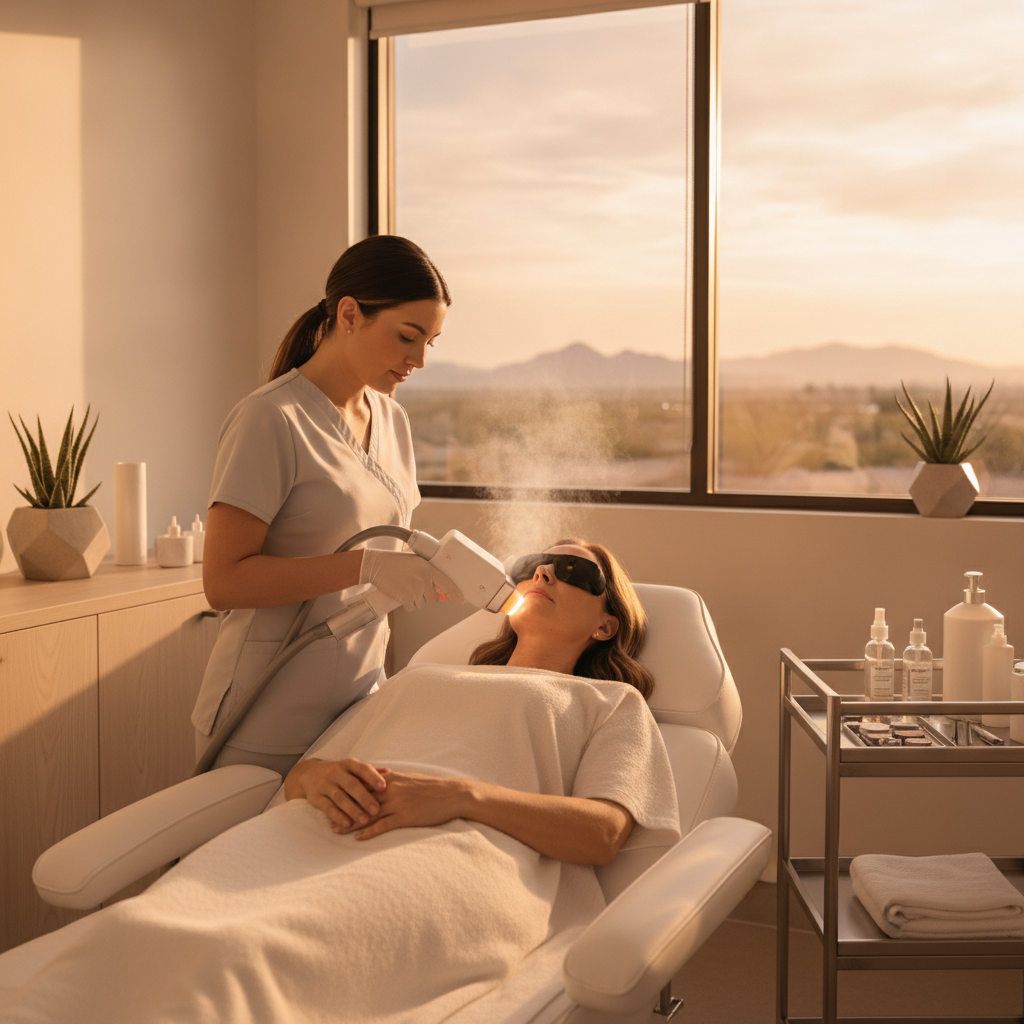
What Is Laser Skin Resurfacing — and How Do You Know If CoolPeel or Another Resurfacing Treatment Is Right for Your Skin in Tempe and Mesa?
If you’ve been dealing with uneven skin texture, sun spots, fine lines, or a complexion that just looks a little dull despite a solid skincare routine, laser skin resurfacing is probably one of the treatments you’ve come across in your research. And if you live in Tempe, Mesa, or anywhere across the East Valley, you already know that decades of desert sun exposure can do a real number on your skin — accelerating the kind of surface damage that skincare products alone often can’t fully address. The good news is that laser resurfacing has come a long way, and today’s options are more targeted, more customizable, and far more manageable in terms of recovery than older laser technologies. The challenge is knowing which approach is actually right for your skin and your schedule.
What Laser Skin Resurfacing Actually Does
At its core, laser skin resurfacing works by delivering controlled energy to the surface and deeper layers of the skin to stimulate collagen production, remove damaged outer skin cells, and encourage fresh, healthier skin to emerge. The result — when done by an experienced provider — is skin that looks smoother, more even in tone, and noticeably refreshed.
What most people don’t realize going in is that “laser resurfacing” isn’t a single treatment. It’s a category that includes several different technologies and approaches, and they vary significantly in terms of intensity, downtime, and what skin concerns they target best. Choosing the wrong one for your skin type or lifestyle isn’t just ineffective — it can lead to unnecessary discomfort or results that don’t match your expectations.
Ablative vs. Non-Ablative: The Distinction That Actually Matters
The most important distinction in laser resurfacing is whether a treatment is ablative or non-ablative.
Ablative lasers remove the outer layer of skin. They tend to produce more dramatic results but come with real downtime — redness, peeling, and a healing period that can range from a few days to a couple of weeks depending on the depth of treatment. Traditional CO2 lasers fall into this category, and while they’re powerful, they’ve historically required significant recovery time that many people find difficult to schedule around.
Non-ablative lasers work beneath the skin’s surface without removing the outer layer, meaning you can often return to normal activity sooner. Results build gradually over time as collagen remodels, and they work well for maintenance or earlier-stage skin concerns — but they may require more sessions to achieve the same level of improvement as a more intensive ablative treatment.
Where CoolPeel Fits In — and Why It’s Worth Understanding
CoolPeel is a specific type of ablative CO2 laser treatment that sits in a meaningful middle ground between traditional high-intensity resurfacing and lighter, non-ablative options. It uses a SmartXide Tetra CO2 laser to deliver ablative energy in a way that specifically targets superficial skin concerns — sun damage, texture irregularities, fine lines, and dullness — while significantly reducing the thermal buildup that causes prolonged downtime with older CO2 systems.
For many people in the East Valley, that balance matters. You can read more about what CoolPeel involves and what to expect at a consultation on the Az Laser Studio & Medspa CoolPeel page. The short version: most people experience a few days of redness and mild peeling rather than weeks of significant downtime — which makes it far easier to work into a realistic schedule, especially if you’re managing a busy household or career in Mesa or Tempe.
What Conditions Respond Well to Laser Resurfacing
Laser skin resurfacing — whether CoolPeel or another modality — tends to work well for:
- Surface-level sun damage and brown spots from years of UV exposure (a very common concern for longtime Arizona residents)
- Fine lines around the eyes, mouth, and forehead
- Uneven skin texture, including rough patches or enlarged-looking pores
- Mild to moderate skin laxity where the surface looks crepey or tired
- Post-acne scarring that has left the skin’s surface uneven
- Overall dullness and lack of radiance that doesn’t respond to topical products
It’s worth noting that deeper acne scarring, significant skin laxity, or very dark or dynamic pigmentation may respond better to a combination approach — for example, pairing resurfacing with RF microneedling, which targets deeper structural collagen remodeling. A good provider will tell you honestly when a single treatment is the right call and when a combination plan will get you further.
The Competitor Gap Worth Addressing: Skin Type Candidacy for Resurfacing
One area where most competitor medspa websites in the East Valley fall short is explaining how skin tone and type affect candidacy for laser resurfacing — particularly ablative CO2 treatments. This is genuinely important information, and the fact that most local competitors skip over it leaves potential clients guessing.
Ablative CO2 lasers, including CoolPeel, are generally best suited for lighter to medium skin tones (Fitzpatrick Types I–III). For clients with deeper skin tones, the risk of post-inflammatory hyperpigmentation (PIH) — a darkening of the treated skin — is higher with more aggressive ablative approaches. This doesn’t mean resurfacing is off the table for everyone with a deeper complexion; it means the approach needs to be adjusted. Non-ablative treatments, fractional resurfacing at lower settings, or a tailored combination plan may be a safer and equally effective route.
This is exactly the kind of conversation you should be having at a consultation with a qualified provider — not something you should try to figure out on your own from a before-and-after gallery. At Az Laser Studio & Medspa, the medical team assesses your Fitzpatrick skin type, your specific concerns, and your lifestyle before recommending anything. If you’re in Gilbert, Chandler, or Scottsdale and have questions about whether your skin tone makes you a good candidate for resurfacing, a consultation is the right starting point — not a booking form.
What to Expect at a Laser Resurfacing Consultation in Mesa
A good consultation for laser skin resurfacing should cover several things beyond just “here’s the treatment and here’s the price.” Your provider should:
- Assess your skin type, tone, and the specific concerns you want to address
- Ask about your history with sun exposure, skincare products (especially retinoids or acids), and any previous laser or chemical treatments
- Review relevant health history, including any history of cold sores, since some resurfacing treatments can trigger outbreaks and require prophylactic antiviral medication
- Explain what realistic results look like for your specific skin — not just the best-case scenario
- Walk you through the pre-treatment prep and post-treatment care that will affect your results
- Discuss timing relative to your social or professional schedule, since even “low downtime” treatments require a few days of visible healing
If a provider skips most of this and goes straight to booking, that’s a signal worth paying attention to. You can learn more about the Az Laser Studio & Medspa team and their approach to care on the about us page.
Timing Your Treatment in the Arizona Desert
Living in Mesa or Tempe means one thing is always true: the sun is intense, and protecting healing skin from UV exposure after any resurfacing treatment is non-negotiable. Most providers recommend avoiding peak sun exposure during your recovery window and using a high-SPF broad-spectrum sunscreen consistently afterward.
This is why fall and winter — roughly October through February — are popular times for resurfacing treatments across the East Valley. You’re less likely to be outdoors for extended stretches, the UV index is lower, and you can fully commit to sun avoidance during healing. That said, with proper precautions, resurfacing is done year-round. Your provider will give you specific guidance based on the treatment intensity and your own lifestyle.
Frequently Asked Questions
How many laser resurfacing sessions will I need?
It depends on the treatment and your goals. A single CoolPeel session can produce noticeable improvement for surface-level concerns, though many people choose a series of two to three treatments spaced four to six weeks apart for more significant results. Your provider will give you a realistic recommendation at your consultation.
How is laser resurfacing different from a chemical peel or HydraFacial?
Chemical peels and HydraFacials work at the very surface of the skin using chemical or mechanical exfoliation. Laser resurfacing delivers energy at a controlled depth, triggering collagen remodeling that peels and facials can’t replicate. They can complement each other as part of a broader skin health plan, but they serve different purposes.
Can I get laser resurfacing if I have a tan?
Treating tanned skin with ablative lasers increases the risk of uneven pigmentation results. Most providers will ask you to avoid deliberate tanning for at least two to four weeks before treatment and will assess your skin at your appointment before proceeding.
Is laser resurfacing covered by insurance?
No. Laser skin resurfacing for cosmetic concerns is not covered by insurance. Many medspas, including Az Laser Studio & Medspa, offer financing options to help make treatments more accessible — ask about available plans when you book your consultation.
What’s the difference between CoolPeel and full ablative CO2 resurfacing?
Traditional ablative CO2 resurfacing delivers heat more deeply and continuously, which produces intensive results but comes with significant downtime — often seven to fourteen days of visible healing. CoolPeel uses very short, high-intensity pulses that minimize thermal spread, targeting surface concerns with considerably less downtime, typically three to five days of redness and peeling for most people.
Ready to Talk About What Your Skin Actually Needs?
If you’ve been living with sun damage, uneven texture, or skin that looks older than you feel, laser resurfacing may be one of the most effective options available to you — but the right treatment depends entirely on your skin, your goals, and your schedule. The team at Az Laser Studio & Medspa serves clients across Mesa, Tempe, Gilbert, Chandler, and the greater East Valley with a consultation-first approach and FDA-cleared technology. There’s no pressure, no one-size-fits-all recommendation, and no guesswork.
Request your free consultation today and find out which resurfacing approach — or combination of treatments — makes the most sense for where your skin is right now.