
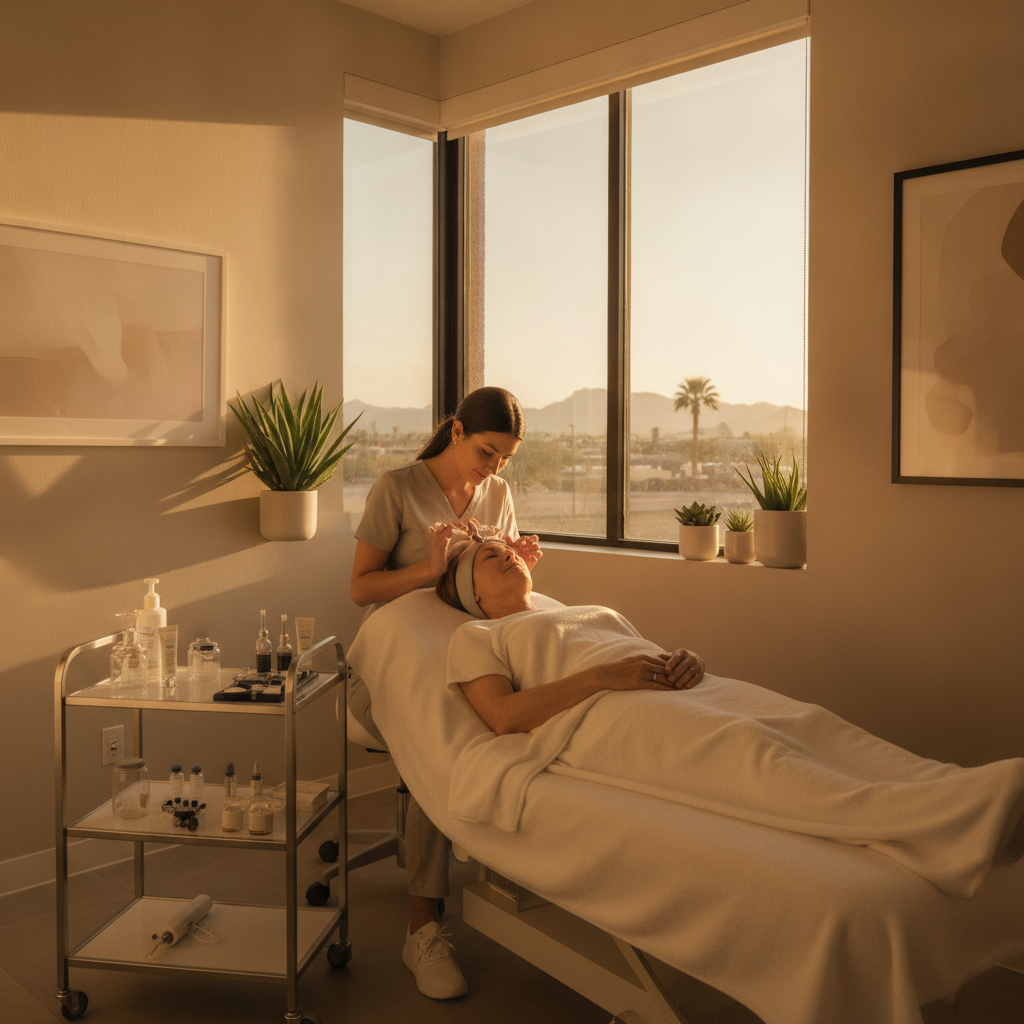
What Happens to Your Skin in the Arizona Heat — and How Mesa Residents Are Treating Sun Damage Year-Round
If you’ve lived in Mesa for more than a summer or two, you already know what the sun can do to a car interior, a wood fence, and a garden. What’s less talked about — and what most local medspa websites gloss over entirely — is what that same relentless UV exposure does to your skin over months and years, and what you can actually do about it beyond sunscreen and wishful thinking. The short answer: sun damage is cumulative, it shows up differently on different skin types, and there are clinical-grade treatments available right here in the East Valley that address it at the source — not just on the surface.
Why Arizona’s Climate Is Uniquely Hard on Skin
Mesa averages over 300 sunny days a year, and UV index readings in the summer regularly hit 11 or higher — well into the “extreme” category. But here’s what catches a lot of people off guard: UV radiation doesn’t disappear when temperatures drop. Even in January and February, when snowbirds flood the East Valley and the weather feels perfectly comfortable for outdoor activities, UV levels in the Greater Phoenix metro remain high enough to cause skin damage with sustained exposure.
That means if you’re spending time outdoors in Tempe, commuting through Chandler, or running errands in Gilbert, your skin is accumulating UV exposure essentially year-round — not just during pool season. For people who’ve lived in Arizona for a decade or more, or who moved here from a cloudier climate without adjusting their skincare habits, this adds up in very visible ways.
What Sun Damage Actually Looks Like on Your Skin
Sun damage isn’t a single condition — it’s a collection of skin changes that occur when UV radiation disrupts normal cell behavior over time. The most common signs people notice in their 30s, 40s, and beyond include:
- Brown spots and hyperpigmentation — clusters of darker pigment that appear on the face, chest, hands, and shoulders
- Uneven skin tone — a loss of the uniform color that skin naturally has in younger years
- Rough or thickened texture — the surface of the skin can feel less smooth as cell turnover slows and damage accumulates
- Fine lines and early wrinkles — UV exposure accelerates collagen breakdown, which means lines can appear earlier and more deeply in sun-heavy environments like Arizona
- Visible capillaries and redness — chronic sun exposure can cause small blood vessels near the surface to dilate and become more visible
- Dullness — even without obvious spots or lines, sun-damaged skin often has a tired, flat quality that good skincare products alone can’t fully correct
What makes this particularly relevant for East Valley residents is the combination of intensity and duration. You’re not getting one bad sunburn a year at the beach — you’re absorbing UV exposure on your morning walk, in your car, walking through a parking lot in Queen Creek, or sitting near a window at work in Scottsdale. It accumulates quietly.
Why Sunscreen Alone Isn’t Enough After Damage Has Set In
Sunscreen is essential — genuinely. But it prevents future damage; it doesn’t address what’s already there. If you’re already seeing brown spots, uneven tone, or textural changes, you need treatments that work below the surface to clear existing pigment, stimulate collagen, and resurface skin at a cellular level. That’s where clinical treatments come in — and why more Mesa residents are turning to medspas rather than relying on over-the-counter products that simply aren’t formulated to reach deep enough.
The Treatments That Actually Address Sun Damage — and How to Match Them to Your Skin
Not all sun damage is the same, and not all treatments are right for every person. A good consultation with an experienced provider will help determine which approach — or combination of approaches — makes sense for your skin type, tone, and specific concerns. Here’s a practical breakdown of what’s commonly used for sun-damaged skin in the East Valley.
IPL Facial (Intense Pulsed Light)
IPL is one of the most effective tools for targeting pigmentation and redness caused by sun exposure. The light energy is absorbed by melanin in brown spots and by hemoglobin in visible vessels, breaking them up so the body can clear them naturally. It works well for people with fair to medium skin tones who have diffuse sun spots, ruddiness, or uneven tone across larger areas of the face, chest, or hands. Most clients need a series of treatments spaced a few weeks apart, and the results tend to build with each session. You can learn more about how IPL facial treatment works and what to expect during the process.
CoolPeel Laser Resurfacing
CoolPeel is a CO2 laser treatment that resurfaces the outer layer of the skin to address texture, fine lines, sun damage, and pigmentation with less downtime than traditional ablative lasers. It’s a strong option for people who want meaningful improvement in skin quality but can’t afford a week of significant downtime. In Arizona’s dry climate, post-treatment skin care and sun avoidance are especially important, and your provider will walk you through exactly what to expect.
RF Microneedling
Radiofrequency microneedling works differently from IPL or laser — instead of targeting pigment directly, it stimulates collagen and elastin production deep in the skin. It’s particularly effective for improving overall skin quality, addressing fine lines, reducing the appearance of enlarged pores, and tightening skin that’s lost its firmness from years of sun and heat exposure. It works across a wider range of skin tones than some laser options, making it a versatile tool for the diverse clientele across the East Valley. Explore the RF microneedling service page for more detail on candidacy and what a session involves.
Medical-Grade Facials and Chemical Peels
For clients with milder sun damage or those who want to maintain their results between more intensive treatments, medical-grade facials and chemical peels provide meaningful improvement in tone and texture. These aren’t the same as spa facials — they use clinical-strength formulations designed to accelerate cell turnover, fade pigmentation, and prep skin for other treatments.
The Gap Most Local Medspa Websites Don’t Fill: Seasonal Treatment Timing in Arizona
Here’s something that comes up in consultations constantly but is rarely explained well online: when is the best time to treat sun damage in Arizona? In most parts of the country, fall and winter are the ideal window for laser and resurfacing treatments because UV exposure drops significantly. In Arizona, that logic still applies — but the calendar looks different.
The best time to schedule IPL, CoolPeel, or other light-based treatments in the East Valley is generally from October through March, when you can realistically avoid intense sun exposure during the healing period. Summer treatments aren’t impossible, but they require stricter sun avoidance, which is genuinely harder to manage in Mesa when UV intensity is at its peak and you’re stepping outside every day. Your provider will discuss timing with you based on your specific treatment plan and lifestyle — but it’s worth knowing going in that the fall and winter months fill up quickly at local medspas, especially with snowbird clients arriving in the Valley who are also looking to address years of cumulative sun exposure.
What to Expect at a Consultation for Sun Damage in Mesa
A thorough consultation will include a skin assessment, a conversation about your concerns and goals, and an honest recommendation about which treatments — or combination of treatments — make the most sense for you. A provider who simply sells you on the most expensive option without asking about your skin history, medications, or lifestyle isn’t giving you a personalized plan. Look for a medspa with licensed medical providers and physician oversight, where your treatment plan is tailored to you specifically, not handed out the same way to every client who walks in.
Az Laser Studio & Medspa serves clients throughout Mesa and the surrounding East Valley — from Gilbert and Chandler to Tempe and Scottsdale — with an experienced team that prioritizes realistic expectations and safe, results-focused care.
Frequently Asked Questions About Sun Damage Treatment in Mesa
Can you treat sun damage in the summer in Arizona?
It’s possible, but more demanding. Light-based treatments like IPL and CoolPeel require diligent sun avoidance during healing, which is harder to maintain when UV intensity is at its highest. Many providers recommend planning these treatments for fall through early spring. RF microneedling and chemical peels have more flexibility with timing and are sometimes a better fit for summer scheduling.
How many treatments will I need to see real improvement?
It depends on the treatment and the extent of damage. IPL typically requires a series of three to five sessions. CoolPeel may show significant results in one to two sessions. RF microneedling is often done in a series of three to four. Your provider will give you a realistic timeline during your consultation rather than overpromising after a single appointment.
Will my brown spots come back after treatment?
Treated spots can be effectively cleared, but new sun damage can develop if you return to unprotected sun exposure. Maintaining results means consistent sunscreen use, protective clothing, and periodic maintenance treatments — especially in an environment like Arizona where sun exposure is unavoidable.
I have a darker skin tone. Are these treatments safe for me?
Skin tone is an important factor in selecting the right treatment. Some laser and light-based options carry a higher risk of post-inflammatory hyperpigmentation in darker skin tones and require more careful settings or alternative approaches. RF microneedling is generally considered safer across a broader range of skin tones. An experienced provider will assess your specific skin type before recommending any treatment.
Is there anything I should do to prepare my skin before a treatment?
Your provider will give you specific pre-treatment instructions, but common recommendations include avoiding direct sun exposure and self-tanners for at least two weeks before treatment, stopping certain topical retinoids temporarily, and arriving with clean skin. Staying well-hydrated is also especially important in Arizona’s dry desert climate, as hydrated skin tends to respond better to treatments and recover more comfortably.
Ready to Address Your Sun Damage? Start With a Consultation.
If you’ve been putting off dealing with brown spots, uneven tone, or rough texture because you weren’t sure where to start, a consultation is the right first step — not a commitment to any particular treatment. The team at Az Laser Studio & Medspa will look at your skin, listen to your goals, and give you an honest, personalized recommendation. Reach out to schedule your free consultation today and find out which approach makes the most sense for your skin and your lifestyle right here in the East Valley.