
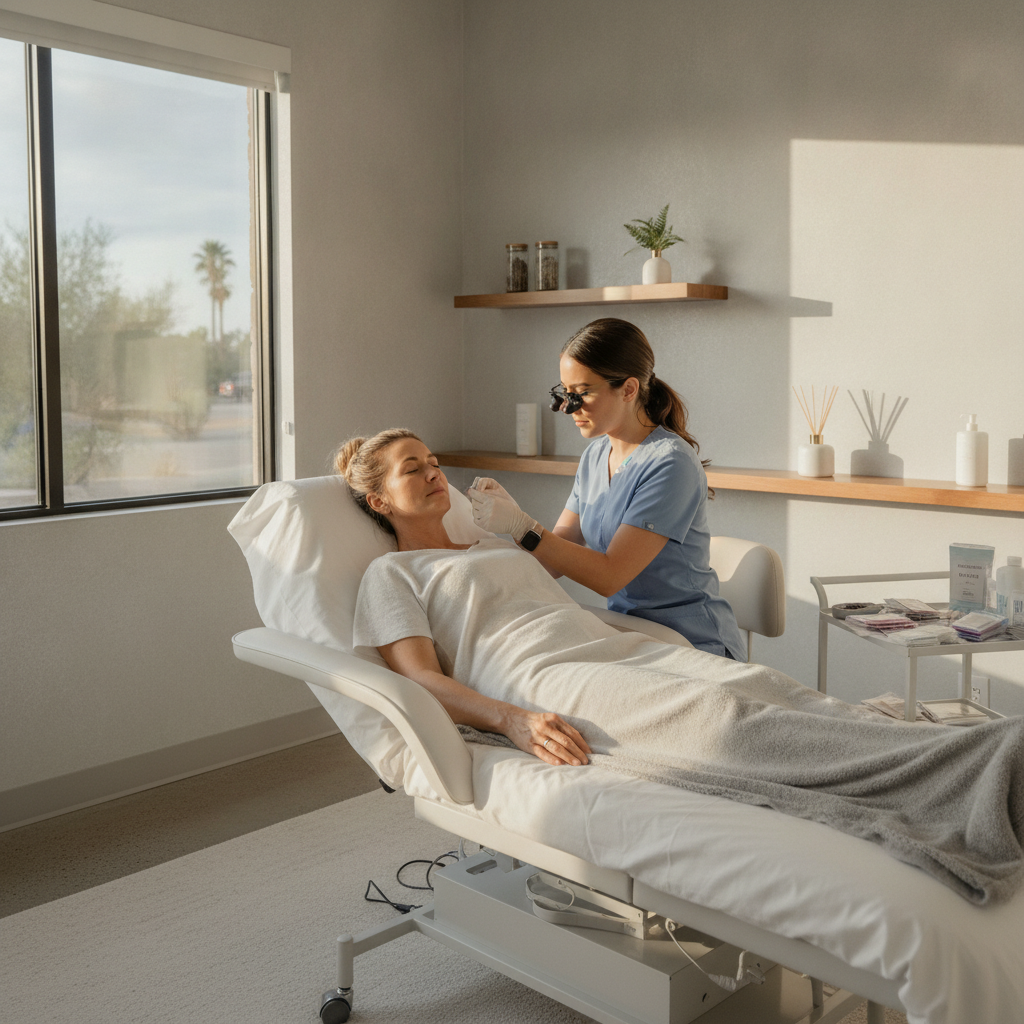
What Are PDO Threads — and Are You a Good Candidate for a Non-Surgical Lift in Mesa and Queen Creek?
PDO (polydioxanone) threads are one of the most talked-about treatments in the medspa world right now — and one of the least explained. If you’ve been noticing some softening along your jawline, a little droop near the brows, or jowling starting to show, you may have searched for options and come across thread lifts. The short answer: yes, PDO threads are a real, clinically used treatment that can provide visible lifting and skin tightening without surgery, and they’ve become a go-to option for men and women across Mesa, Queen Creek, and the broader East Valley who want meaningful results without going under the knife. But like any aesthetic procedure, the details matter — including whether you’re actually a good candidate, what the treatment involves, and how to find someone qualified to perform it.
What Are PDO Threads, Exactly?
PDO stands for polydioxanone, the same dissolvable suture material that’s been used safely in surgery for decades. In aesthetics, ultra-fine PDO threads are inserted just beneath the skin using a thin needle or cannula. Once placed, they do two things: they provide immediate mechanical lifting by physically repositioning tissue, and they stimulate your body’s natural collagen production as they gradually dissolve over the following months.
There are two main types of PDO threads used in medspa settings:
- Smooth (mono) threads: These don’t lift on their own — they’re placed in a grid or mesh pattern to stimulate collagen and improve skin texture and firmness. They’re often used for fine crepey skin on the neck, under the eyes, or on the lower face.
- Barbed (cog) threads: These have tiny barbs or cogs along the thread that physically grip and reposition tissue, providing the actual “lift.” These are what most people mean when they say “thread lift.”
The threads dissolve on their own within roughly four to six months, but the collagen they stimulate continues to provide structure and firmness for a year or longer. Results are gradual and natural-looking — not a dramatic surgical transformation, but a genuine improvement in lift, definition, and skin quality.
What Areas Can PDO Threads Treat?
Thread lifts are most commonly used on the mid-face, jawline, jowl area, brows, and neck — essentially anywhere early-to-moderate sagging or volume descent is showing up. Common treatment zones include:
- Jowls and jawline definition
- Cheek and mid-face lifting
- Brow elevation
- Nasolabial fold softening
- Neck and submental area (often paired with Kybella or other treatments)
- Crepey skin on the décolletage or arms (smooth threads)
PDO threads can also be combined with dermal fillers like Sculptra or Radiesse for a more comprehensive result — threads lift and tighten while fillers restore volume. When placed by an experienced provider, the two complement each other well without looking overdone.
Are You a Good Candidate for a Thread Lift?
This is the question most medspa websites gloss over — and it’s exactly where we want to be direct with you, because candidacy really does matter with this treatment.
PDO threads tend to work best for adults who are experiencing mild to moderate skin laxity and tissue descent — not severe sagging that would require surgical correction. Here’s a more honest breakdown of who typically sees the best outcomes:
- Good candidates: Adults generally in their late 30s to 60s with good baseline skin quality who have noticed early jowling, mild brow descent, or softening of facial contours. Those who want improvement but aren’t interested in or ready for surgery. Those with healthy skin who are non-smokers or former smokers.
- May need a different approach: Those with significant skin excess — think multiple inches of loose tissue — where threads simply can’t provide enough repositioning. Very thin skin can sometimes make threads more visible or palpable. Active skin infections, autoimmune conditions, or blood-thinning medications may also affect candidacy.
The right provider will tell you honestly whether threads alone will get you where you want to go, or whether a combination approach — or a referral for a surgical consultation — is more appropriate for your situation. If a clinic is selling thread lifts to everyone who walks in without a proper assessment, that’s a red flag.
What Does the Procedure Actually Feel Like — and What’s the Downtime?
Before treatment, a topical numbing cream is applied, and local anesthetic is used at the insertion points. Most clients describe the procedure as a mild pressure sensation rather than sharp pain. The actual thread placement typically takes 30 to 60 minutes depending on the number of threads and areas being treated.
Immediately after, you may notice:
- Some swelling, redness, and mild bruising at insertion sites — usually resolving within a week
- Slight skin puckering or dimpling at first (this smooths out as swelling subsides)
- Tenderness with chewing or facial movement for several days
Most clients can return to normal daily activity within a few days, though heavy exercise, facial massage, and sleeping on your side are typically restricted for the first week or two. It’s not a zero-downtime procedure — but it’s a far cry from surgical recovery.
Results start becoming visible as swelling resolves, with the full collagen-stimulating effect continuing to improve over the following three to six months.
What Competitors in the East Valley Aren’t Telling You About Thread Lifts
Here’s the gap worth addressing: most local medspa sites that mention PDO threads provide very little detail about provider training, technique variation, or realistic outcome expectations. Threads require a strong working knowledge of facial anatomy — insertion at the wrong depth or angle can cause asymmetry, migration, or visible bunching under the skin. This is not a treatment where experience level is a minor footnote.
When evaluating a medspa for thread lifts in Mesa, Gilbert, or anywhere in the East Valley, ask directly:
- Who performs the thread placement — what is their clinical background?
- Is there medical director oversight for advanced procedures like threads?
- How many thread lift procedures has this provider performed?
- Can you see before-and-after photos from their actual clients?
- What thread brand and type do they use, and why?
At Az Laser Studio & Medspa, PDO threads are performed by experienced licensed providers under physician oversight. A thorough consultation comes first — because the goal is always a result that looks like you, just refreshed. You can learn more about our medical team and credentials here.
How Do PDO Threads Fit Into a Broader Treatment Plan?
Thread lifts aren’t usually a standalone solution for most clients — they’re one tool in a broader strategy. For clients in their late 30s or 40s dealing with early laxity, threads can be an excellent entry point into structural rejuvenation. For clients who’ve already been doing neurotoxins and fillers, threads may be the next step to address what injectables alone can’t fully correct.
Common pairings include:
- Threads + Sculptra or Radiesse for lift combined with volumization
- Threads + RF microneedling to address skin texture and tightening at a different depth
- Threads + neurotoxins for full upper and lower face rejuvenation
Your provider should be helping you think through the sequence and timing — not just recommending what sells. In the East Valley’s competitive medspa market, the clinics that build long-term client relationships are the ones giving honest, personalized guidance from the first consultation onward.
Frequently Asked Questions About PDO Threads in Mesa and Queen Creek
How long do PDO thread results last?
The threads themselves dissolve within four to six months, but the collagen stimulation they trigger can maintain visible results for 12 to 18 months or longer, depending on the individual. Maintenance treatments can extend results over time.
Are PDO threads safe?
PDO is a well-established medical material with a long safety record. As with any procedure, complications are possible — most commonly temporary bruising, swelling, or mild asymmetry — and the risk is significantly reduced when treatment is performed by a trained, experienced provider under appropriate medical oversight.
Can I combine thread lifts with Botox or filler at the same appointment?
In some cases, yes — but it depends on the areas being treated and your provider’s assessment. Your consultation will help clarify what can safely be done together versus staged over separate visits.
Does the Chandler or Queen Creek area have limited access to thread lift providers?
Residents in outer East Valley communities like Queen Creek and Chandler sometimes assume they need to travel into central Scottsdale for advanced aesthetic treatments. Az Laser Studio & Medspa in Mesa is centrally located along major East Valley corridors and serves clients from across the region.
What should I avoid before a thread lift appointment?
Your provider will give you specific pre-treatment instructions, but common guidance includes avoiding blood-thinning supplements (like fish oil and vitamin E), NSAIDs like ibuprofen, and alcohol in the days leading up to your appointment to minimize bruising risk.
Ready to Find Out If PDO Threads Are Right for You?
The best way to know whether a thread lift fits your goals is to talk with a qualified provider who will look at your actual anatomy and skin quality — not just a treatment menu. If you’re in Mesa, Queen Creek, Gilbert, or anywhere in the East Valley and you’re curious about what PDO threads could do for you, Az Laser Studio & Medspa offers personalized consultations with an experienced team that takes the time to understand your goals before recommending any treatment.
Request your free consultation today and find out whether a thread lift — or a customized combination approach — is the right next step for you.