
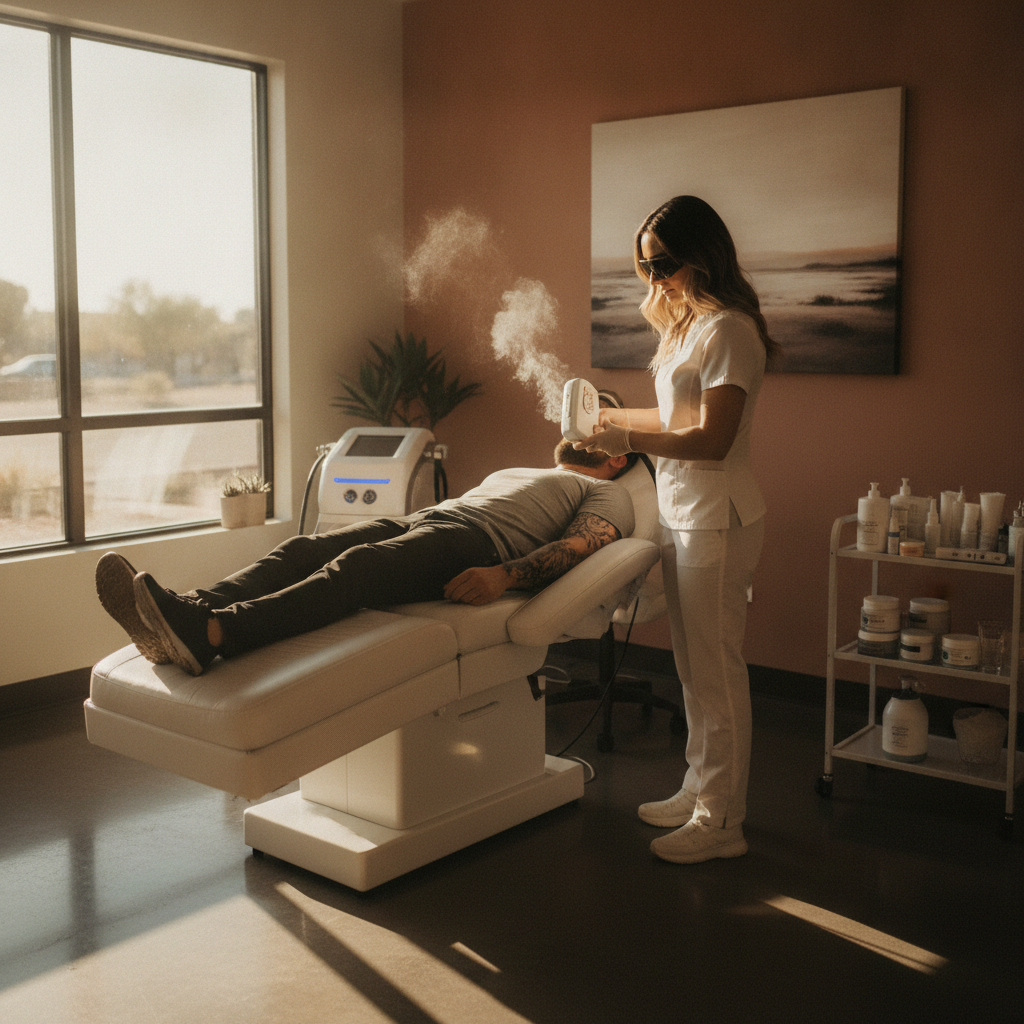
What Is Laser Tattoo Removal Really Like — and How Many Sessions Do You Actually Need in Mesa and Tempe?
If you’ve been Googling laser tattoo removal in Mesa or Tempe and getting vague, half-answered results, you’re not alone. Most local medspa websites list it as a service and leave it at that — a paragraph, maybe a photo, and a phone number. What they don’t tell you is what actually happens during treatment, why the number of sessions varies so widely, or what makes certain tattoos harder to remove than others. This article covers all of it, so you can walk into a consultation knowing the right questions to ask.
How Laser Tattoo Removal Actually Works
Laser tattoo removal uses concentrated pulses of light energy to break apart the ink particles beneath your skin. Your immune system then gradually clears those fragmented particles over the weeks following each treatment. That’s the key detail that most people miss: the laser doesn’t erase the tattoo in one session — it initiates a process your body continues long after you leave the treatment room. Each session pushes the fading further, and the time between sessions is just as important as the treatment itself.
Modern laser systems use different wavelengths to target different ink colors. Darker inks — black, dark blue, dark green — tend to respond fastest because they absorb the most laser energy. Lighter colors like yellow, light green, and sky blue absorb less energy and typically require more sessions to fade effectively. Multi-colored tattoos are almost always the most complex cases, and any provider worth your time will be upfront about that during your consultation.
How Many Sessions Will You Actually Need?
This is the question everyone asks — and the honest answer is that it depends on several factors that no website can predict without seeing your tattoo in person. That said, here are the variables that matter most:
- Ink density and saturation: Heavily saturated professional tattoos take longer to clear than lighter, older work.
- Tattoo age: Older tattoos have already experienced some natural fading and often respond more quickly.
- Ink colors: Black and dark colors clear faster; light pastels and fluorescent inks are the most resistant.
- Your skin tone: Laser settings are adjusted based on your skin’s melanin levels. A skilled provider will calibrate the treatment appropriately, but skin tone does influence the approach.
- Location on the body: Tattoos on areas with stronger circulation — like the upper arms or torso — tend to fade faster than those on hands, feet, or ankles.
- Amateur vs. professional tattoos: Counterintuitively, amateur tattoos done with uneven ink distribution sometimes fade faster than precise professional work.
Most clients can expect somewhere between 5 and 12 sessions for significant fading or full removal, spaced roughly 6 to 8 weeks apart. Some straightforward cases resolve in fewer sessions; complex multi-colored or densely saturated tattoos can take longer. A reputable provider will give you an honest range after evaluating your specific tattoo — not a firm number that sets unrealistic expectations.
Why the Arizona Climate Actually Matters for Your Treatment Plan
Living in the East Valley comes with a built-in consideration that most tattoo removal guides don’t mention: sun exposure. Phoenix-area residents spend more time in the sun year-round than people in most other parts of the country. Sun exposure on a treatment area before or after a laser session can increase the risk of hyperpigmentation or irritation. Your provider will typically advise you to keep the treated area out of direct sunlight and apply SPF diligently between sessions.
For that reason, some clients in Mesa, Tempe, and Gilbert choose to start their tattoo removal process in the fall or winter months — not because treatment is impossible in summer, but because it’s easier to protect the area from sun when you’re naturally covering up more. That said, tattoo removal can absolutely be done year-round with the right aftercare protocol in place.
What the Fading Process Actually Looks Like — Session by Session
One of the most common surprises for first-time clients is that results aren’t linear. You might notice significant lightening after your first or second session, then feel like progress slows before picking back up again. That’s completely normal. Your immune system’s clearing ability varies, and some sessions will produce more visible change than others.
Immediately after a session, the treated area typically looks frosted or whitish — that’s a normal response to the laser energy. You may also notice some redness, swelling, and occasionally small blisters in the days following treatment, all of which resolve with proper aftercare. Most people describe the sensation as similar to a rubber band snapping against the skin, and many providers offer topical numbing to make the experience more comfortable.
Between sessions, the most important things you can do are protect the area from sun, keep the skin moisturized, avoid picking at any scabbing, and stay well-hydrated. Clients who take good care of the area between appointments consistently report better results over time.
What Most Competitor Websites Don’t Tell You: Candidacy Beyond Skin Tone
Most medspa websites in the East Valley that offer tattoo removal mention skin tone as a candidacy factor and leave it there. But there are other candidacy considerations that deserve more attention.
If your tattoo was done with ink that contains metallic compounds — certain flesh-toned inks and some older permanent makeup pigments — laser treatment can sometimes cause oxidation that temporarily darkens the area before it eventually lightens. This doesn’t mean you can’t be treated, but it does mean your provider needs to know about it before they start.
Tattoos over scarred tissue or with raised keloid-prone edges also require a modified approach. And if you have a history of cold sores in or near the treatment area, your provider may recommend antiviral prophylaxis before treatment. None of these factors are deal-breakers — they’re just reasons why a thorough consultation before your first session matters more than it might seem.
At Az Laser Studio & Medspa, the consultation process is designed to assess all of these factors so your treatment plan is built around your specific tattoo, skin, and goals — not a one-size-fits-all protocol.
What to Look for in a Tattoo Removal Provider in Mesa or Scottsdale
The East Valley has no shortage of options when it comes to laser services, so how do you choose? A few things worth evaluating before you commit:
- The laser technology they use: Q-switched and picosecond lasers are the clinical standard for tattoo removal. Ask specifically what system is being used and whether it has multiple wavelengths to address different ink colors.
- Who is performing the treatment: In Arizona, laser treatments should be administered by or under the supervision of a licensed medical professional. Ask about provider credentials and medical director oversight.
- Whether they do a test spot: For clients with uncertain skin reactions or complex tattoos, a test spot on a small area before committing to full treatment is a reasonable precaution.
- Realistic communication: Any provider who guarantees full removal in a specific number of sessions without seeing your tattoo is oversimplifying. Honest providers give ranges, not promises.
- Before-and-after photos from actual clients: In the East Valley, Google reviews and visual results carry a lot of weight — and rightfully so. Look for providers with documented results on tattoos similar to yours.
Is Laser Tattoo Removal Worth It? What Chandler and Gilbert Clients Often Ask
Many clients in the Greater Phoenix area come in not necessarily wanting full removal — they want significant fading so they can get a cover-up tattoo, or they want to clear a visible piece before a job interview or life change. Laser removal is highly effective for fading even when full clearance isn’t the goal, and partial fading often opens up more creative options for a cover-up artist. If you’re in that situation, be upfront about your end goal during your consultation so the treatment plan reflects what you actually want.
Pricing varies based on tattoo size, complexity, and number of sessions, and many clients in the East Valley appreciate that medspa financing options have become more accessible in recent years. If cost is a factor in your planning, ask about package pricing or payment plans when you call.
Frequently Asked Questions About Laser Tattoo Removal in Mesa
Does laser tattoo removal hurt?
Most clients describe the sensation as a sharp snapping feeling — similar to a rubber band or the snap of hot grease. It’s brief and localized. Topical numbing cream is typically applied before treatment to reduce discomfort, and sessions are usually short depending on the size of the tattoo.
How far apart do sessions need to be?
Most providers recommend waiting 6 to 8 weeks between sessions to give your immune system adequate time to clear the broken-down ink particles. Rushing sessions too close together doesn’t speed up the process — it can actually compromise results and skin recovery.
Can all ink colors be removed?
Dark inks like black and dark navy respond best to laser treatment. Lighter colors — especially yellow, light green, and sky blue — are more resistant and may require additional sessions or not fully clear. A consultation will help you understand what to expect for your specific tattoo’s ink palette.
Will laser tattoo removal leave a scar?
When performed correctly by a qualified provider using appropriate settings for your skin type, laser tattoo removal should not cause scarring. The risk increases with improper technique, incorrect settings, or inadequate aftercare. This is one reason why provider selection and credentials matter significantly.
Is it safe to get tattoo removal in the summer in Arizona?
Yes, tattoo removal can be done year-round in Mesa and the surrounding East Valley. The key is diligent sun protection before and after each session. Your provider will give you specific aftercare instructions, and wearing SPF on the treated area consistently between sessions is non-negotiable in our climate.
Ready to Start? Schedule a Consultation in Mesa
If you’ve been sitting on the fence about laser tattoo removal, a consultation is the most useful first step you can take. There’s no commitment involved — it’s an opportunity to have your tattoo evaluated, get an honest session estimate, and understand what the process will actually look like for your specific situation.
Az Laser Studio & Medspa serves clients throughout Mesa, Tempe, Gilbert, Chandler, Scottsdale, and the broader East Valley. Our team takes a consultation-first approach to every service we offer, and you can request your free consultation here. Come in with your questions — we’re straightforward with our answers.