
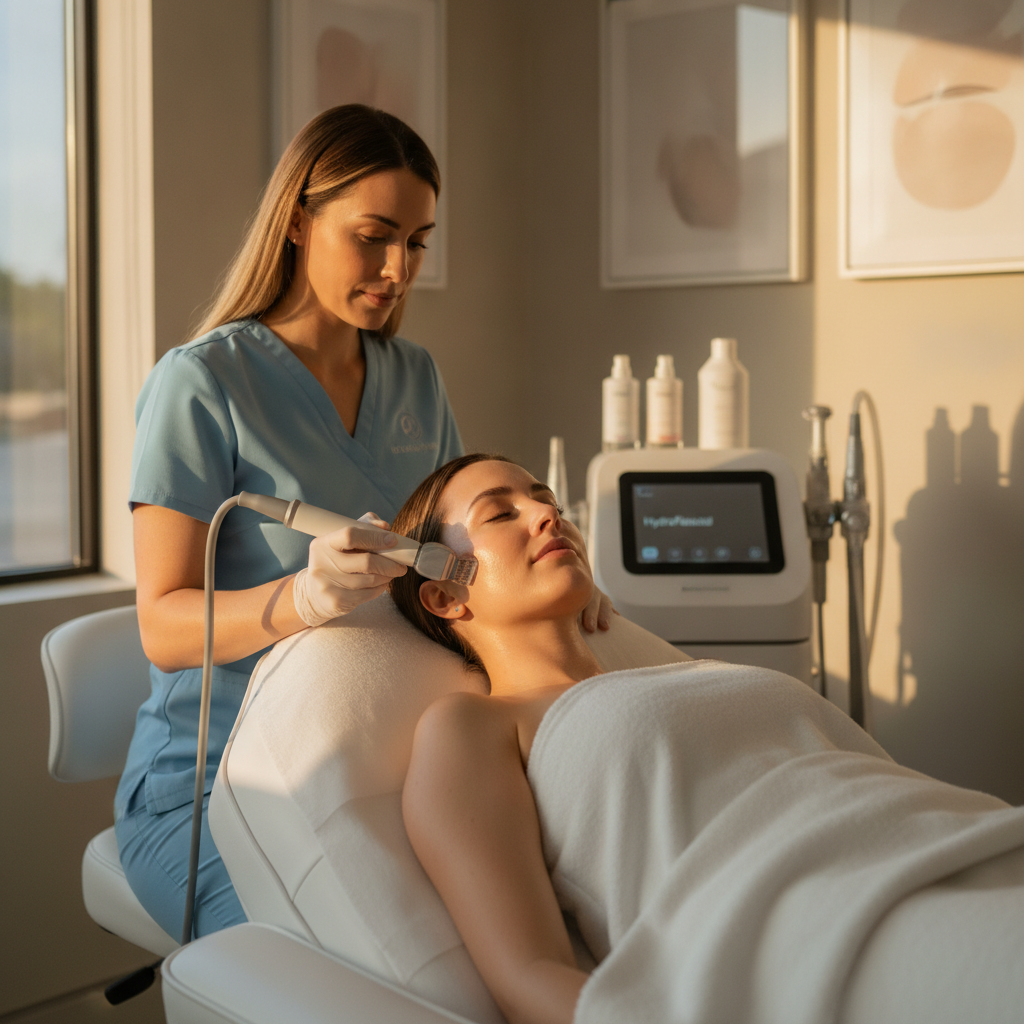
What Is a HydraFacial — and Why Are Clients in Mesa and Scottsdale Calling It Their Favorite Lunchtime Treatment?
A HydraFacial is a multi-step, medical-grade facial treatment that cleanses, exfoliates, extracts, and deeply hydrates your skin — all in a single session with no downtime. If you’ve been hearing about it from friends, coworkers, or scrolling past before-and-after photos online, you’re not imagining the buzz. In Mesa and across the East Valley, it’s consistently one of the most requested treatments at reputable medspas, and with good reason. You walk in with congested, dull, or dehydrated skin and walk out looking noticeably more refreshed — usually in about 30 to 45 minutes.
If you’ve been curious but weren’t sure what’s actually involved, this guide covers everything you need to know: what the treatment does, who it works well for, how it compares to a regular spa facial, and why it fits so naturally into life in the desert Southwest.
What Actually Happens During a HydraFacial?
The treatment uses a patented Vortex-Fusion technology — a handheld wand that simultaneously exfoliates and infuses your skin with targeted serums. It’s not a single action; it’s a layered process that moves through your skin in stages. Here’s what a standard session typically includes:
- Cleansing and exfoliation: A gentle resurfacing peel loosens dead skin cells and debris from the surface without causing irritation or redness.
- Acid peel: A mild glycolic and salicylic acid solution is applied briefly to loosen congestion — much gentler than a traditional chemical peel, with none of the extended downtime.
- Extraction: A painless vortex suction clears out pores without the manual squeezing that can cause inflammation or post-facial breakouts.
- Hydration infusion: Antioxidants, hyaluronic acid, and peptides are delivered directly into the skin through the same wand — feeding the skin while it’s freshly opened and most receptive.
- Protection: A final layer of moisturizers and broad-spectrum SPF helps lock in results and shield the treated skin from UV exposure.
Add-ons like lymphatic drainage, LED light therapy, or boosters targeting specific concerns — like brightening, anti-aging, or clarifying — can be layered in depending on what your skin needs that day.
Why the Desert Climate Makes This Treatment Especially Relevant
Living in Mesa means your skin is dealing with conditions most facial treatments weren’t designed around. The combination of low humidity, high UV index, extreme heat in summer, and dry air year-round creates a specific kind of skin stress: chronic surface dehydration, accelerated sun damage, and a tendency for pores to clog with sunscreen, sweat, and environmental particulate matter.
A HydraFacial addresses all three of those issues in one appointment. The exfoliation step clears the buildup that accumulates faster in a hot, dusty climate. The extraction step unclogs pores that get congested under daily sunscreen use — a non-negotiable in Arizona. And the hydration infusion does something no over-the-counter moisturizer can easily replicate: it delivers moisture directly below the surface layer, where it can actually be used by skin cells.
That’s why clients in Gilbert, Chandler, Tempe, and across the East Valley tend to respond particularly well to this treatment — and why many keep booking it monthly rather than treating it as a one-time thing.
Who Is a Good Candidate for a HydraFacial?
One of the things that sets this treatment apart from more targeted procedures is how broadly it works. It’s effective across a wide range of skin types and concerns, including:
- Dull, tired-looking skin that needs a visible refresh
- Congested pores or mild blackhead buildup
- Uneven texture or rough surface feel
- Dehydrated skin that feels tight or looks flat
- Fine lines caused by dryness rather than deep volume loss
- Early sun damage and mild pigmentation concerns
- Sensitive skin that doesn’t tolerate more aggressive treatments well
It also works well for people who are newer to medspa treatments and want something that produces visible results with essentially zero recovery time. There’s no peeling, no social downtime, and no reason you can’t go right back to your workday or afternoon plans. That’s where the “lunchtime facial” nickname comes from — and it’s not an exaggeration.
If you have active, severe acne, open wounds, or certain skin conditions, your provider will want to assess your skin first and may recommend an alternative approach or a different sequence of treatments.
How Is a HydraFacial Different From a Regular Spa Facial?
This is a question that comes up often, and the distinction matters. A traditional spa facial relies mostly on manual techniques — hands, cloths, steam, and whatever skincare products happen to be on the treatment menu that day. Results vary considerably depending on the esthetician’s skill and the quality of the products used. There’s also a higher risk of post-facial irritation or breakouts from manual extractions if they’re not done carefully.
A HydraFacial uses FDA-cleared technology with standardized, medical-grade serums that are specifically formulated to work with the device. The delivery mechanism — vortex suction and infusion — allows actives to penetrate more effectively than topical application alone. Because it’s performed in a medspa setting with licensed providers, it can also be combined with other treatments in a way a day spa facial typically can’t.
For example, many clients at Az Laser Studio & Medspa pair a HydraFacial with an IPL facial session or use it as a prep treatment before or after RF microneedling to support healing and optimize hydration. That kind of treatment stacking simply isn’t possible in a traditional spa environment.
What Competitors Aren’t Telling You: How Often Should You Actually Get One?
This is one area where content across many local medspa websites goes frustratingly vague. Most competitor sites list HydraFacial as a service but don’t explain the difference between a one-time session and a maintenance program — which is where real skin improvement happens.
A single HydraFacial will leave your skin looking and feeling noticeably better immediately after treatment. You’ll see more brightness, tighter-looking pores, and improved texture within 24 hours. Those results typically last about a week to two weeks before your skin naturally cycles back toward its baseline.
For lasting skin improvement — not just a refresh — most providers recommend monthly sessions, at minimum. In Arizona’s climate, where skin turnover is stressed by UV exposure and chronic dehydration, some clients benefit from every three to four weeks. Over four to six months of consistent treatments, you’ll typically notice cumulative improvements in tone, texture, and pore appearance that a single session can’t deliver on its own.
When you come in for a consultation at Az Laser Studio & Medspa, your provider will look at your skin and help you build a realistic maintenance plan — not a one-size-fits-all schedule, but one based on what your skin actually needs and your lifestyle.
Can a HydraFacial Be Combined With Other Medspa Treatments?
Yes — and this is where it becomes a particularly smart addition to a broader treatment plan. Because it’s so well-tolerated and carries no meaningful downtime, it pairs well with a wide range of other services. Common combinations include:
- HydraFacial followed by RF microneedling to prep the skin and support recovery
- HydraFacial between rounds of laser skin resurfacing to maintain hydration and even tone
- HydraFacial as a regular standalone treatment while undergoing a laser hair removal series — keeping skin conditioned in between sessions
- HydraFacial with LED light therapy add-on for additional calming or brightening support
Your provider can walk you through what makes sense based on the other treatments you’re already receiving or considering.
Frequently Asked Questions About HydraFacials in Mesa
Does a HydraFacial hurt?
No — most clients describe the sensation as a gentle, slightly cool vacuum feeling against the skin. It’s comfortable enough that many people find it relaxing. There’s no pain involved.
How long does a HydraFacial take?
A standard HydraFacial session typically takes 30 to 45 minutes. Add-on treatments like LED therapy or lymphatic drainage can extend that to about an hour.
Is there any downtime?
No. Your skin may look slightly pink immediately after, but this usually fades within an hour or two. You can apply makeup and go about your day right after the appointment.
How soon will I see results?
Most clients notice visibly brighter, smoother skin immediately after their session. Results continue to improve over the following 24 to 48 hours as your skin settles.
Is a HydraFacial good for men’s skin too?
Absolutely. Men in Mesa and Scottsdale who deal with congested pores, rough texture, or sun-weathered skin respond very well to HydraFacial. It’s gender-neutral, effective, and fits easily into a busy schedule.
Ready to See What a HydraFacial Can Do for Your Skin?
If you’ve been wondering whether a HydraFacial is worth it — or if you’re looking for a reliable, no-downtime treatment to build into your regular routine — the best next step is a conversation with a licensed provider who can actually look at your skin and give you honest guidance. At Az Laser Studio & Medspa in Mesa, every new client starts with a personalized consultation so you understand exactly what to expect before committing to anything.
We serve clients throughout Mesa, Scottsdale, Gilbert, Chandler, Tempe, and the surrounding East Valley. Contact us today to schedule your free consultation and find out whether a HydraFacial — or a combination of treatments tailored to your skin — is the right fit for you.