
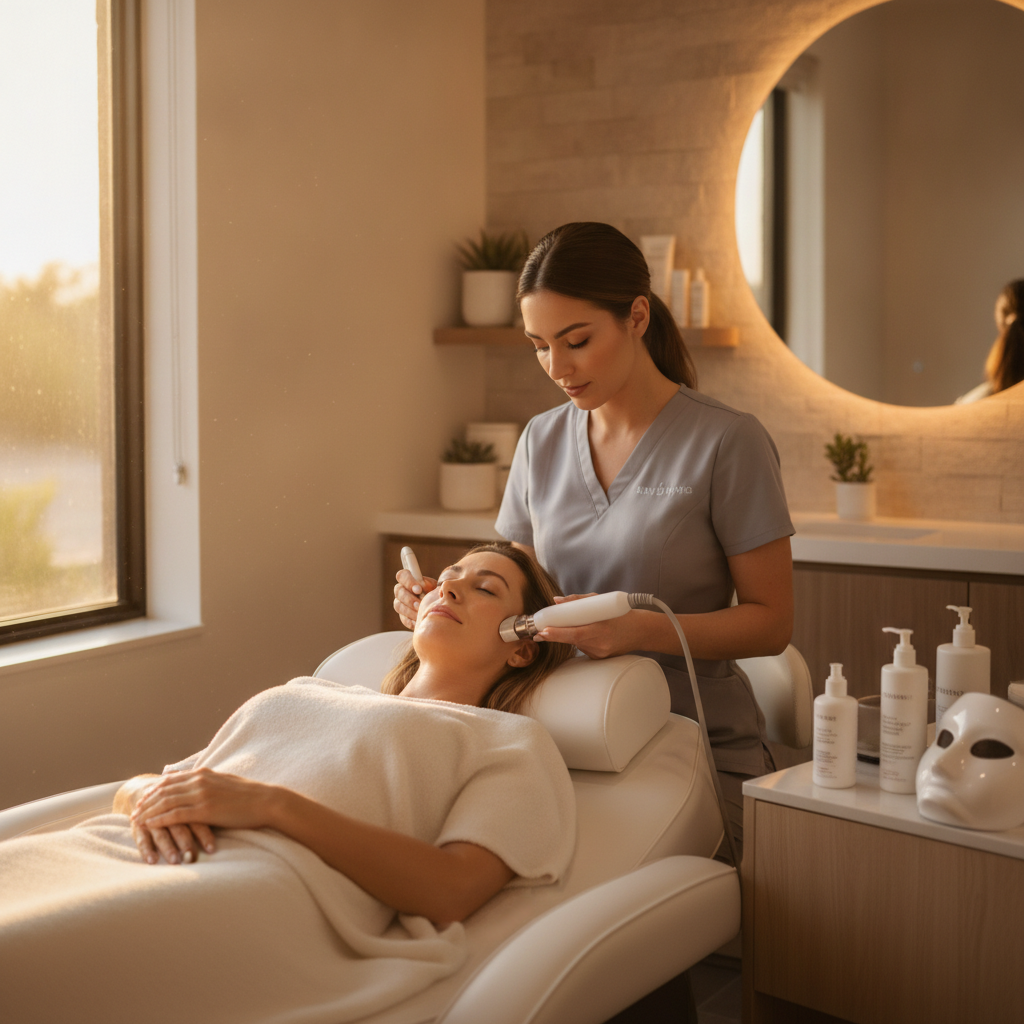
What Is a Medical-Grade Facial — and How Is It Different From a Spa Facial for Residents in Queen Creek and Mesa?
If you’ve been booking facials at a traditional day spa and wondering why your skin isn’t really changing, you’re not alone. A lot of people across Queen Creek, Mesa, and the broader East Valley go through the same cycle — relaxing treatment, soft music, warm towels — and then look in the mirror two weeks later wondering what they actually paid for. The honest answer is that most spa facials are designed around comfort and relaxation, not clinical results. A medical-grade facial is something different: it’s a treatment built around your skin’s actual biology, performed by a licensed provider with professional-grade tools and ingredients your esthetician at a day spa simply isn’t permitted to use.
That distinction matters more than most people realize — especially here in the desert, where year-round sun exposure, dry heat, and wide temperature swings put your skin under constant stress. Understanding what separates these two types of facials can help you make smarter decisions about where you spend your skincare budget.
The Core Difference: Ingredients, Depth, and Provider Training
A traditional spa facial typically uses over-the-counter or cosmetic-grade products. These products are formulated to be safe for use without professional supervision, which also means they’re limited in how deeply they can penetrate the skin or how aggressively they can address specific concerns. That’s not a knock on the estheticians performing them — they’re working within the bounds of what they’re licensed to apply.
Medical-grade facials, on the other hand, use pharmaceutical or clinical-grade ingredients that are formulated at higher concentrations — acids, retinoids, growth factors, and other actives that require a trained hand and often a provider’s oversight to use safely. At a medspa like Az Laser Studio & Medspa in Mesa, your provider can assess your skin type, identify underlying concerns like hyperpigmentation, acne congestion, or early sun damage, and then customize your treatment accordingly. The difference in what’s possible is significant.
What Medical-Grade Facials Can Actually Address
This is where the gap between spa and medspa really opens up. Spa facials are excellent for hydration, relaxation, and general maintenance. But if you’re dealing with any of the following, a clinical-level facial is likely going to serve you much better:
- Sun damage and uneven pigmentation — Common in East Valley residents who spend time outdoors year-round
- Acne and post-acne scarring — Requires specific acids and treatment protocols, not just extractions
- Rough texture and enlarged pores — Medical-grade exfoliation works at a depth that consumer products can’t reach
- Dullness and dehydration — Especially relevant in the dry desert climate around Mesa and Queen Creek
- Early fine lines — Certain clinical formulations support collagen production in ways that standard facial products don’t
- Redness and sensitivity — Providers can choose targeted actives appropriate to your skin barrier
Many of these concerns can also be addressed through complementary treatments like medical-grade chemical peels, which use carefully controlled acid solutions to resurface the skin at a deeper level than a typical facial. Your provider can help you decide which approach — or which combination — makes sense for where your skin is right now.
What to Expect During a Medical-Grade Facial at a Medspa
One thing that surprises a lot of first-time medspa clients is how thorough the intake process is. You’re not just lying down and letting someone apply product — your provider will ask about your skin history, current products, medications, hormonal changes, and any sensitivities before touching your face. That conversation shapes what your treatment actually involves.
From there, a medical-grade facial typically includes a deep cleanse, a professional-level exfoliation step, targeted treatment serums or masques chosen for your specific concerns, and often some form of extraction or lymphatic drainage. Depending on the protocol, you may experience mild redness or sensitivity afterward — that’s normal and generally resolves within hours to a day. The results, though, tend to be noticeably more pronounced than what you’d see after a traditional spa treatment.
Most providers recommend a series of treatments spaced about three to four weeks apart for optimal results, with maintenance appointments every four to six weeks after that. Your skin’s response will guide the timeline.
The Gap Most Local Competitors Aren’t Filling: Skincare as a System, Not a One-Time Event
One thing that’s notably missing from the content on many competing medspa sites in the East Valley is a clear explanation of how facials fit into a broader skincare plan. Most competitor pages simply list their facial services with a brief description and a booking link. What they don’t explain is that medical-grade facials work best as part of a layered approach — paired strategically with treatments like RF microneedling, IPL, or laser resurfacing depending on your goals.
For example, if you’re dealing with significant sun damage from years of outdoor living in the Queen Creek or Mesa area, a series of medical-grade facials can prime your skin and maintain results between more intensive treatments. If you’re working on texture and tone, pairing facials with a treatment like CoolPeel or IPL may accelerate your progress in ways that either treatment alone wouldn’t achieve. Your provider’s job isn’t just to perform individual services — it’s to help you understand how those services work together over time.
That kind of personalized, system-based approach is something the team at Az Laser Studio & Medspa takes seriously. Every treatment plan starts with a real consultation, not just a menu selection.
Medical-Grade vs. Spa Facial: A Quick Comparison
- Product strength: Medspa facials use clinical-grade actives; spa facials use cosmetic-grade products
- Provider qualifications: Medspa treatments are performed or supervised by licensed medical professionals; spa estheticians are licensed for cosmetic services only
- Customization: Medical-grade facials are tailored to your skin concerns and conditions; spa facials typically follow a set protocol
- Results depth: Medspa treatments can address clinical concerns; spa facials are best for maintenance and relaxation
- Downtime: Medical-grade facials may cause mild redness or flaking depending on the protocol; spa facials generally have no downtime
- Long-term impact: With consistent medspa treatment, you should see measurable improvement in skin texture, tone, and clarity over time
How to Know You’re Choosing the Right Medspa in Gilbert, Chandler, or Across the East Valley
Not every business that calls itself a medspa actually operates with medical oversight — and that matters when clinical-grade products and treatments are involved. When you’re evaluating options, ask whether there’s a licensed medical director overseeing protocols, what credentials the person actually performing your treatment holds, and whether the facility uses FDA-cleared or professional-only product lines. A provider who asks about your health history and takes time to understand your goals before recommending anything is a good sign.
You can learn more about the team behind Az Laser Studio & Medspa and the credentials they bring to every treatment on the about us page.
Frequently Asked Questions
How is a medical-grade facial different from a HydraFacial?
A HydraFacial is actually a type of medical-grade facial — it uses a specific patented device that cleanses, exfoliates, extracts, and infuses the skin simultaneously using vortex suction. Other medical-grade facials may use different modalities like enzyme treatments, professional-strength peels, or specialized masques depending on your skin’s needs. Your provider can help you determine which approach is the best fit.
How many sessions will I need before I see results?
Many clients notice a visible difference after a single medical-grade facial, particularly in terms of brightness and texture. For more stubborn concerns like hyperpigmentation or acne scarring, a series of four to six treatments spaced three to four weeks apart tends to produce the most meaningful improvement. Consistency matters.
Can I combine a medical-grade facial with other medspa treatments?
Yes — and in many cases, combining services strategically is where you’ll see the most significant results. Facials pair well with treatments like IPL, RF microneedling, or laser resurfacing, though your provider will typically recommend spacing certain treatments appropriately to avoid overloading the skin. This is something to discuss during your consultation.
Is there downtime after a medical-grade facial?
It depends on the specific protocol. Many medical-grade facials have little to no downtime — mild redness or sensitivity that resolves within a few hours. If your treatment includes a more active chemical exfoliant or peel component, you may experience some flaking or peeling over the next two to three days. Your provider will tell you exactly what to expect based on your treatment plan.
Are medical-grade facials safe for sensitive skin?
Yes, when performed by a qualified provider. One of the advantages of a medspa setting is that your provider can adjust ingredient concentrations and product choices based on your skin’s sensitivity level. People with rosacea, reactive skin, or compromised skin barriers often do well with carefully selected clinical protocols that a general spa treatment wouldn’t be able to offer.
Ready to See What a Real Clinical Facial Can Do for Your Skin?
If you’ve been maintaining your skin with spa facials and aren’t seeing the progress you want, a medical-grade facial at Az Laser Studio & Medspa in Mesa might be exactly what your skin needs. Whether you’re dealing with desert sun damage, uneven tone, persistent breakouts, or just want skin that actually looks and feels better — our team will take the time to understand your goals and build a plan that makes sense for you. Financing through Cherry is available, so cost doesn’t have to be a barrier to getting started.
Request your free consultation today and find out what a personalized, clinically guided approach to skincare can do for you.