
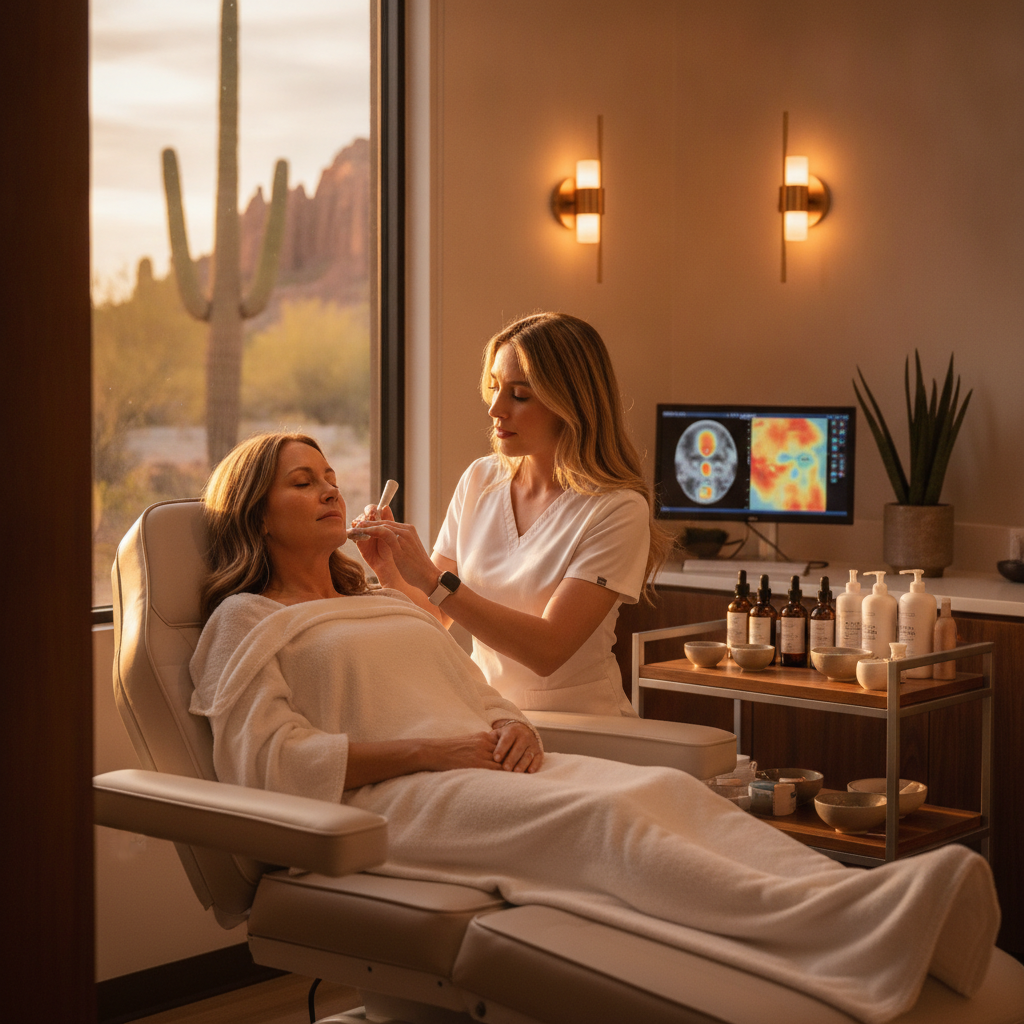
What Happens to Your Skin in the Arizona Desert — and How Mesa Residents Can Actually Fix Sun Damage Year-Round
If you’ve lived in Mesa — or anywhere across the East Valley — for more than a few years, your skin has been taking on more UV exposure than you probably realize. Arizona sits at a high elevation with intensely low humidity, and the Sonoran Desert delivers over 300 days of sunshine annually. That’s not just a fun weather stat. It’s a real, cumulative stressor on your skin. The good news is that several medspa treatments available right here in Mesa are specifically designed to address what desert living does to your complexion — and you don’t have to wait for a specific season to start.
Why Desert Sun Damage Is Different From What You Read About in National Skincare Guides
Most mainstream skincare content is written for general audiences — people living in the Pacific Northwest, the Midwest, or along the coasts where UV index levels are moderate and sun exposure is seasonal. That advice doesn’t fully apply here. In the Greater Phoenix metro, UV index readings regularly hit 10 or 11 during summer months, which is classified as “extreme.” But even in January and February — when snowbirds from cooler climates are arriving and enjoying the outdoors — the UV index in Mesa still runs moderate to high.
The result is a pattern of skin damage that builds quietly over years: brown spots and sun spots (technically called solar lentigines), uneven skin tone, broken capillaries near the surface, rough or leathery texture, and early loss of skin elasticity. People who moved here from other states often notice their skin aging faster than expected — not because anything is wrong with them, but because the cumulative UV load in the desert is simply higher than what their skin was accustomed to.
This is a topic you won’t find discussed in depth on most local competitor medspa websites. They list treatments. They don’t explain the regional skin context that makes those treatments especially relevant for people living between the US-60 corridor and the Superstition Mountains.
What Sun Damage Actually Looks Like on Desert Skin
Sun damage doesn’t always show up immediately. Some of what you’re seeing in your 30s, 40s, or 50s is the result of cumulative exposure from your 20s and earlier. Here’s what tends to show up most commonly in clients across Mesa, Chandler, Gilbert, and Tempe:
- Hyperpigmentation and brown spots: Flat, irregular patches of darkened skin, most common on the face, chest, and hands — areas that get the most incidental sun exposure.
- Redness and visible capillaries: Chronic sun exposure can dilate small blood vessels near the skin’s surface, contributing to persistent flushing or rosacea-like redness.
- Rough skin texture: UV damage breaks down collagen over time, leading to a coarser surface feel and enlarged-looking pores.
- Dullness and uneven tone: Desert air is chronically dry, and sun exposure compounds dehydration-related dullness, making skin look flat and tired.
- Fine lines and early laxity: Collagen loss from UV exposure shows up as fine lines around the eyes, mouth, and forehead — often earlier than expected for someone’s actual age.
Which Treatments Actually Address Sun Damage — and When to Use Each One
Here’s where it helps to have a clear map of your options. Not all treatments target the same problem, and layering them strategically — ideally with the guidance of a licensed provider — tends to produce better results than choosing just one.
IPL Facial: The Go-To for Brown Spots and Redness
Intense Pulsed Light (IPL) is one of the most well-matched treatments for Arizona sun damage because it directly targets pigmented lesions and vascular irregularities. The light energy is absorbed by melanin (in dark spots) and oxyhemoglobin (in redness), causing those structures to break apart and fade over the following weeks. Most clients need a series of treatments for optimal results, and it’s especially effective on lighter skin tones with noticeable contrast between the spots and surrounding skin. Timing matters here in the desert — IPL facials are generally best performed in fall through early spring, when your skin isn’t actively tanned from summer outdoor activities.
CoolPeel Laser Resurfacing: When Texture and Lines Are the Main Concern
If your skin’s texture, surface roughness, or fine lines are more noticeable than pigmentation, a fractional CO2 laser treatment like CoolPeel may be the more targeted choice. CoolPeel delivers controlled energy to the outermost skin layers, stimulating fresh collagen production and reducing the appearance of sun-induced textural changes. It works especially well for clients in their late 30s through 50s who’ve accumulated significant desert UV exposure over the years. Downtime is typically a few days of redness and peeling — more than an IPL treatment, but the collagen remodeling benefits tend to be deeper and longer-lasting.
RF Microneedling: For Collagen Rebuilding and Skin Tightening
Radiofrequency microneedling combines the collagen-stimulating effect of micro-channels in the skin with RF energy delivered below the surface. It’s a strong choice for addressing the collagen loss that accumulates from years of desert UV exposure — particularly for skin that’s starting to feel less firm or look less bouncy than it used to. A series of RF microneedling sessions spaced about a month apart is the typical starting point, with maintenance treatments helping to sustain results over time.
HydraFacial: Maintenance, Hydration, and Surface Renewal
Living in a low-humidity desert environment means your skin is dealing with chronic moisture loss on top of UV stress. A HydraFacial won’t reverse deep pigmentation on its own, but it plays an important role in a well-rounded skin health routine — clearing congestion, boosting hydration, and keeping your skin prepped and receptive for more targeted treatments. Many clients in Scottsdale and Mesa use HydraFacial monthly as a maintenance layer alongside seasonal laser or IPL treatments.
Medical-Grade Chemical Peels: Targeted Exfoliation With a Plan
Medical-grade peels use higher-concentration acids than anything available over the counter, and they can be customized to address specific concerns — brightening for hyperpigmentation, resurfacing for texture, or calming for inflamed or sun-stressed skin. The depth and formulation matter significantly, which is why these should always be administered by a trained provider who can assess your skin type and layering history. Fall through winter is peak peel season in Arizona for a reason: treated skin is photosensitive, and avoiding intense sun exposure post-treatment is much easier when temperatures drop and outdoor time naturally decreases.
What Most Medspa Sites in the East Valley Don’t Tell You: Treatment Timing in Arizona Is Everything
One meaningful gap across competitor content in this market is the near-total absence of guidance on when to schedule certain skin treatments in a desert climate. This matters more here than almost anywhere else in the country. Laser treatments, IPL, and chemical peels all create temporary photosensitivity — meaning your skin is more vulnerable to UV damage immediately after treatment. In a climate with extreme UV year-round, that’s not a casual consideration.
As a general principle: the fall and winter months — roughly October through March — are the most favorable window for laser resurfacing, IPL, and deeper peels in the Mesa area. That’s not because those treatments can’t be done in summer; it’s because post-treatment sun avoidance is genuinely easier to maintain when it’s not 112 degrees and you’re not outside as much. Spring and summer are often better suited for treatments with minimal photosensitivity risk, like RF microneedling, HydraFacial, and certain surface-level facials. A good provider will walk you through a seasonal treatment calendar that makes sense for your skin and your lifestyle.
Frequently Asked Questions
Can sun damage from years of living in Arizona actually be reversed?
Much of it can be significantly improved. Brown spots, uneven tone, and surface texture often respond very well to treatments like IPL and laser resurfacing. Deep structural changes — like significant collagen loss — take longer to address but can be improved over time with consistent treatment and a quality at-home skincare routine.
Is it safe to do laser or IPL treatments in the summer in Mesa?
Many laser treatments can be performed year-round with proper precautions, but certain modalities carry a higher risk of post-inflammatory hyperpigmentation if the skin is actively tanned. Your provider will evaluate your current skin tone and sun exposure habits before recommending a treatment plan. Fall through early spring is generally the preferred window for more aggressive resurfacing in Arizona.
How many treatments will I need to see a real difference in my sun-damaged skin?
It depends on the treatment and how much cumulative damage is present. IPL for brown spots typically involves a series of 3–5 sessions. CoolPeel or RF microneedling may show meaningful results in 2–4 sessions. Your provider can give you a realistic timeline during a consultation based on your specific skin concerns.
I moved to the East Valley from a cooler climate and my skin aged faster than expected. Is it too late to do something about it?
Not at all — and you’re not alone. Many clients who relocated to the Mesa and Chandler area from the Pacific Northwest, Midwest, or Northeast notice accelerated skin aging within just a few years. The good news is that skin responds to treatment at any age, and a combination approach addressing pigmentation, texture, and collagen loss can produce very meaningful improvements.
Do I need a consultation before starting treatment for sun damage?
Yes — and any reputable medspa should require one. Sun damage presents differently on every skin type, and the ideal treatment sequence for someone with Fitzpatrick skin type II is different from the ideal plan for someone with a deeper complexion. A thorough consultation protects you and helps ensure you’re investing in treatments that will actually work for your specific skin.
Ready to Start Addressing Your Desert Sun Damage?
At Az Laser Studio & Medspa, we’ve built our treatment approach around the specific skin realities of living in Arizona’s desert climate. Our licensed, experienced team serves clients across Mesa, Gilbert, Chandler, Tempe, and Scottsdale — and we take a personalized, consultation-first approach to every treatment plan. Whether you’re dealing with years of accumulated brown spots, rough texture, persistent redness, or a combination of all three, we’ll help you figure out what will actually make a difference for your skin.
Schedule your free consultation today and get a clear, honest plan for what your skin needs — and what it doesn’t.