
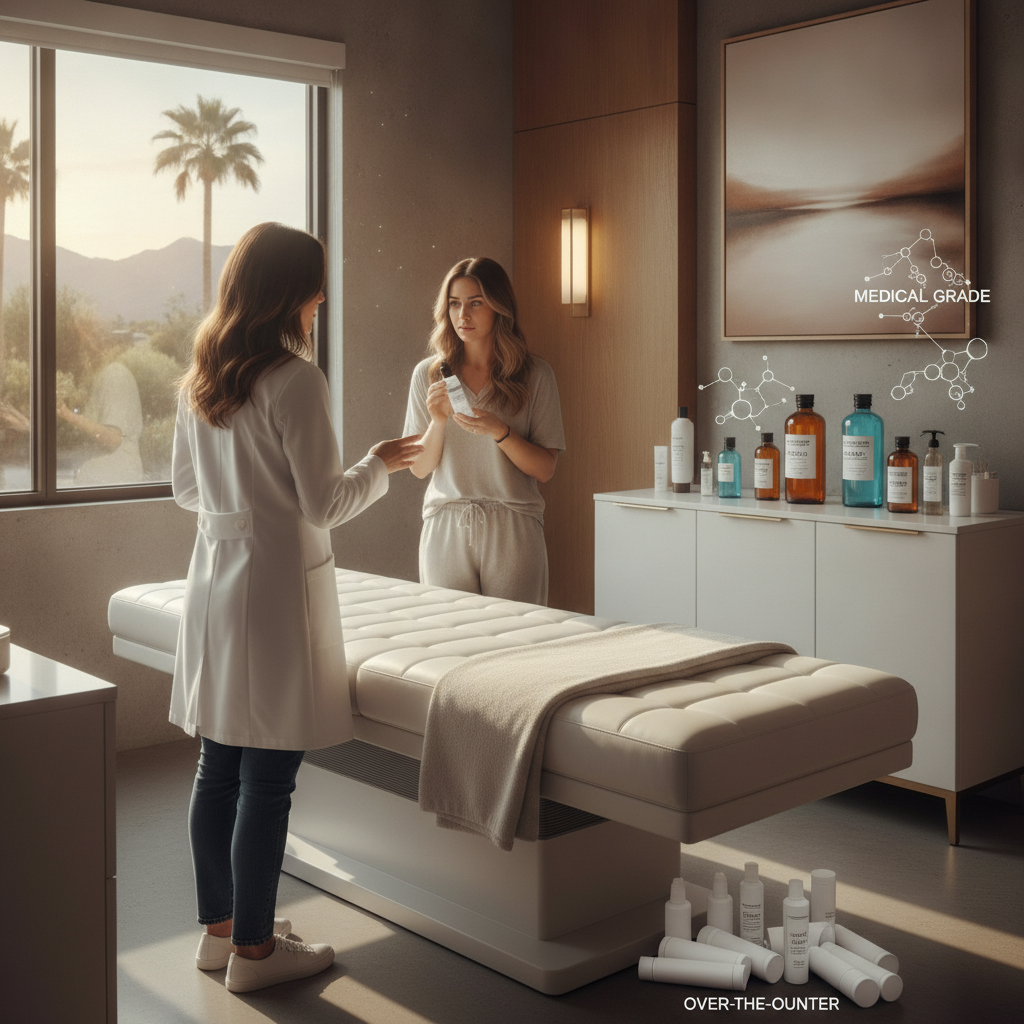
What Is the Difference Between Medical-Grade Skincare and Drugstore Products — and Why Does It Matter for Gilbert and Mesa Residents?
If you’ve been faithfully applying your drugstore serums and moisturizers for months without seeing the changes you hoped for, you’re not doing anything wrong — you may simply have outgrown what over-the-counter products can deliver. In Mesa, Gilbert, and across the East Valley, this is one of the most common conversations that happens during a medspa consultation. The honest answer is that medical-grade skincare and drugstore products are not the same thing, and understanding that difference can save you both money and frustration in the long run.
The Core Difference: Ingredient Concentration and Skin Penetration
The biggest distinction between medical-grade skincare and what you’ll find at a big-box retailer comes down to two things: the concentration of active ingredients and how deeply those ingredients are formulated to penetrate the skin.
Drugstore products are manufactured to be safe for anyone who picks them off a shelf — regardless of skin type, sensitivity, or underlying conditions. To meet that standard, active ingredients like retinol, vitamin C, niacinamide, and peptides are typically included at concentrations low enough to minimize the risk of irritation across a broad population. That’s not inherently bad, but it does mean these products work slowly, if at all, for people dealing with more persistent concerns like hyperpigmentation, acne scarring, textural changes, or visible sun damage.
Medical-grade formulations, on the other hand, are dispensed or recommended through licensed medical professionals — nurse practitioners, registered nurses, or physicians — and are designed to work at a cellular level. Higher concentrations of active ingredients, more sophisticated delivery systems, and pharmaceutical-grade raw materials all contribute to formulations that your skin can actually respond to in a meaningful way.
Why This Matters More in Arizona’s Desert Climate
Living in the East Valley adds a layer of complexity to skincare that residents in more temperate climates simply don’t face. Year-round UV exposure, low humidity, and extreme summer heat create conditions that accelerate skin aging, deepen pigmentation, and compromise the skin barrier faster than most people realize. By the time someone in Mesa, Chandler, or Tempe notices visible sun damage, texture changes, or stubborn discoloration, the concern is typically well past what a hydrating drugstore moisturizer can address on its own.
This is precisely why a growing number of East Valley residents are pairing professional medspa treatments — like HydraFacial, medical-grade chemical peels, and IPL facials — with professionally guided skincare routines at home. Treatments can jump-start results, but what you apply consistently between appointments determines how well and how long those results hold.
Retinol vs. Retinoids: A Good Example of the Concentration Gap
One of the clearest illustrations of the medical-grade vs. over-the-counter divide is the retinol versus retinoid conversation. You’ve probably seen retinol marketed heavily in drugstore anti-aging lines. Retinol is a form of vitamin A that works — but it has to be converted by your skin through multiple steps before it becomes the active compound that actually does the work at a cellular level. The process dilutes its effectiveness significantly.
Medical-grade retinoids (like tretinoin) are already in their active form, or much closer to it, meaning they begin influencing cell turnover and collagen stimulation more efficiently and at a deeper level. That’s why prescription-strength retinoids have decades of clinical evidence behind them, while drugstore retinol products still carry cautious, hedged marketing language about what they might do over time.
The same logic applies to vitamin C serums, exfoliating acids, growth factors, and peptide formulations — the professional versions are simply built differently, and a licensed provider can match the right formulation to your skin’s actual needs rather than guessing from a product label.
What a Skincare Consultation at a Medspa Actually Looks Like
This is the piece that most competitor websites in the area gloss over — and it’s one of the most practical things to understand if you’re considering making the switch to medical-grade products. A skincare consultation at a reputable medspa isn’t a sales pitch. It’s an assessment.
A qualified provider will look at your skin closely, ask about your current routine, discuss your concerns and goals, and factor in things like your history of sun exposure, any sensitivity patterns you’ve noticed, and whether you’re using any medications that affect the skin. From there, they build a protocol — not just a product list — that accounts for how your skin will respond and in what order to introduce active ingredients without overwhelming your barrier.
This personalized approach is something a drugstore shelf simply cannot replicate, no matter how many “dermatologist-approved” stickers are on the packaging. At Az Laser Studio & Medspa in Mesa, consultations are designed to give you a clear, realistic picture of what professional skincare and in-office treatments can accomplish together — without pressure to buy everything at once.
How Professional Treatments and Medical-Grade Skincare Work Together
Medspa treatments and a professionally guided home routine work as a system, not in isolation. An IPL facial can significantly reduce surface pigmentation, but without the right follow-up products protecting and supporting your skin’s barrier — particularly SPF and antioxidants suited to Arizona’s UV intensity — that improvement won’t hold as well. Similarly, RF microneedling creates the ideal environment for growth factors and peptides to penetrate deeply, making the timing and quality of what you apply post-treatment genuinely impactful.
Providers who understand both sides of this — the in-office treatments and the products that support them — can create a roadmap that actually connects. That’s the conversation worth having, and it’s one that generic skincare counters and big-box beauty retailers simply aren’t equipped to offer.
What to Look for When Choosing Medical-Grade Skincare Through a Medspa
Not all medspas recommend medical-grade skincare the same way, and it’s worth asking a few questions before you commit to any products:
- Who is making the recommendation? A licensed medical professional — not just a front-desk staff member — should be guiding product choices, especially for anything with active concentrations like retinoids, exfoliating acids, or brightening agents.
- Is the recommendation based on your skin, or on general promotions? A trustworthy provider builds a routine around your skin type and concerns, not around which products are easiest to move off the shelf.
- Do they explain how to introduce products gradually? Medical-grade actives can cause purging or sensitivity if introduced too aggressively. A good provider walks you through layering and frequency so you don’t inadvertently compromise your barrier.
- Does the skincare recommendation connect to your in-office treatments? If the provider isn’t asking about what treatments you’re receiving (or recommending), the advice may be too generic to be useful.
Frequently Asked Questions
Can I just buy medical-grade skincare online without a consultation?
Some brands are available online without a prescription, but self-prescribing active formulations without knowing your skin type, sensitivity, and goals is a common way people end up with irritation or wasted products. A short consultation helps you avoid that and often saves money over time.
Are medical-grade products safe for sensitive skin in Scottsdale or Gilbert?
Yes — there are medical-grade formulations designed specifically for sensitive and reactive skin. The difference is that a provider selects the right formulation and concentration for your skin rather than leaving you to guess from marketing copy.
How much more do medical-grade products cost compared to drugstore options?
Medical-grade products typically cost more upfront, but because the active concentrations are higher, you generally use less product to see results. Many clients find the overall value comparable once they factor in how much they were spending on drugstore products that weren’t delivering results.
Do I need to be getting medspa treatments to use medical-grade skincare?
No, but the two often work best together. You can use professional-grade home products independently, and many people start there before adding in-office treatments as their budget and goals evolve.
Does Az Laser Studio & Medspa offer skincare consultations for people in the Mesa and Gilbert area?
Yes. The team at Az Laser Studio & Medspa provides personalized skincare consultations as part of their broader approach to aesthetic wellness. Whether you’re starting from scratch or looking to refine an existing routine, they can help you build something that actually works for the Arizona climate and your specific skin concerns.
Ready to Stop Guessing and Start Seeing Real Results?
If you’ve been spinning your wheels with products that aren’t delivering, it may be time for a different conversation. The team at Az Laser Studio & Medspa in Mesa works with clients from across the East Valley — including Gilbert, Tempe, Chandler, and Scottsdale — to build skincare routines and treatment plans that are grounded in real clinical knowledge, not marketing claims.
Your skin is different from your neighbor’s, and it deserves a plan built for it. Request a free consultation today and find out what a professionally guided approach can do for your skin.