
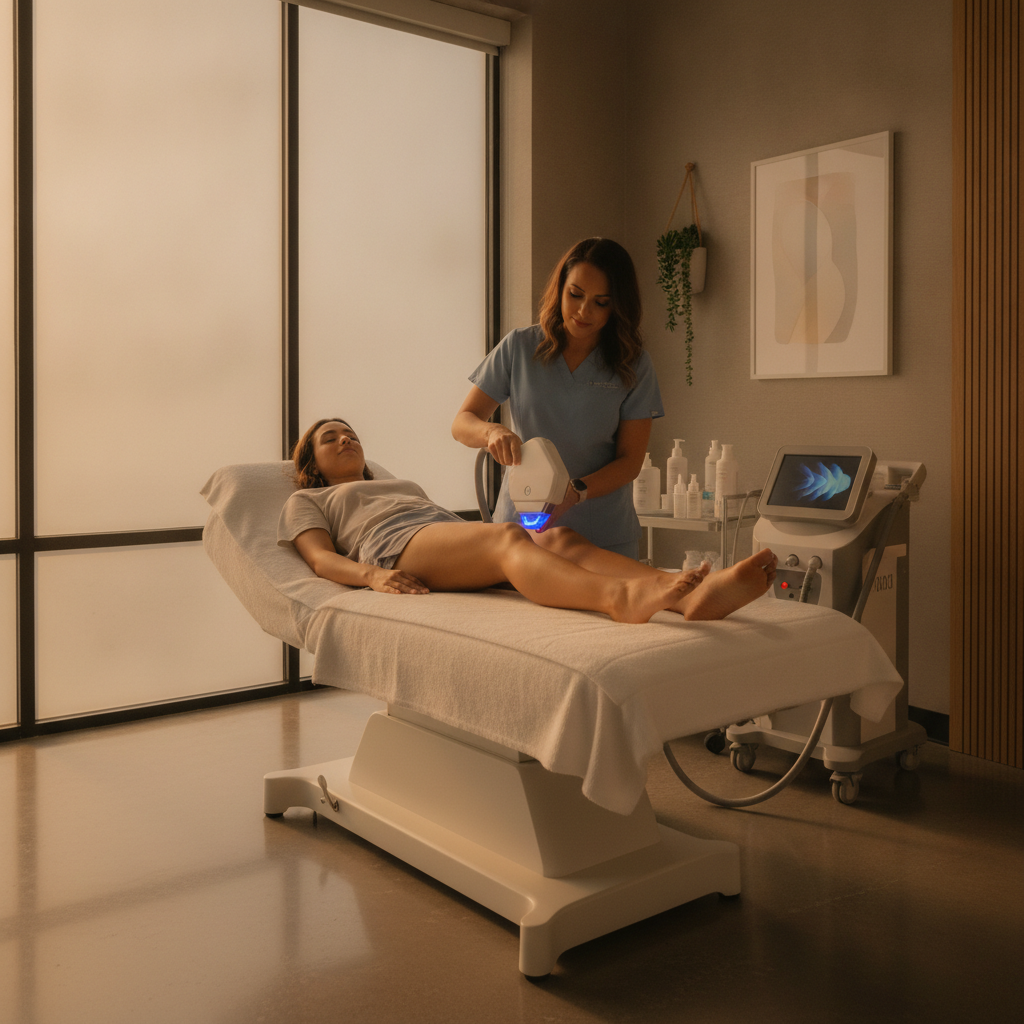
Laser hair removal for dark or tanned skin is absolutely possible — but it requires the right technology, a provider who understands melanin, and a consultation that goes deeper than a quick skin-tone glance. If you live in Mesa, Chandler, or anywhere in the East Valley and you’ve been told to just wax or shave because laser “isn’t for your skin,” that advice is outdated. Here’s what you actually need to know before you book.
Why Skin Tone Matters in Laser Hair Removal — and Why It Doesn’t Have to Be a Dealbreaker
Laser hair removal works by sending concentrated light energy into the hair follicle. The laser targets pigment — specifically, the melanin inside the hair shaft. The goal is for that energy to be absorbed by the hair, not the surrounding skin. The challenge with darker skin tones is that the skin itself also contains more melanin, which means an underpowered or improperly matched laser can inadvertently heat the skin rather than just the follicle.
This is why skin tone matters in treatment planning — not because darker skin can’t be treated, but because it needs to be treated differently. Clinics that use a single laser platform for every client, or that haven’t invested in longer-wavelength technology, may genuinely not be equipped to treat you safely. But a well-equipped provider absolutely can.
In Arizona, this conversation is more relevant than most places. The East Valley has one of the most ethnically and phenotypically diverse populations in the Southwest, spanning every Fitzpatrick skin type. Add to that the fact that most residents are outdoors and sun-exposed for the better part of ten months a year — which means even naturally lighter-skinned clients regularly come in with a significant tan — and skin tone assessment becomes a critical part of every consultation.
What the Fitzpatrick Scale Actually Means for Your Treatment
If you’ve done any research on this topic, you’ve likely come across the Fitzpatrick scale — a classification system that ranges from Type I (very fair, always burns) to Type VI (deeply pigmented, never burns). Types I through III tend to be the easiest to treat with older laser platforms. Types IV through VI — which include many people of South Asian, Middle Eastern, Hispanic, East Asian, and African descent — require more careful approach and the right equipment.
The two laser wavelengths most commonly used for hair removal are 755nm (Alexandrite) and 1064nm (Nd:YAG). Alexandrite lasers are fast and effective for lighter skin types but carry higher risk on darker skin. The Nd:YAG laser, with its longer wavelength, bypasses surface melanin more effectively and penetrates deeper into the follicle — making it the gold standard for Fitzpatrick Types IV–VI. Some newer platforms combine both wavelengths with intelligent skin-sensing technology, giving providers more flexibility across skin tones.
This is why the first question to ask any clinic isn’t “how much does it cost?” — it’s “what laser do you use, and is it appropriate for my skin type?” A provider who can answer that question confidently and explain their reasoning is a provider worth trusting.
The Tanning Problem in Arizona: A Year-Round Factor Most Clinics Don’t Address Well
Here’s a content gap that comes up again and again in this market and that most local competitors barely touch: active tans are one of the most common reasons laser hair removal sessions get postponed in Arizona — and residents here are almost perpetually sun-exposed.
Even clients with naturally lighter skin can arrive to their appointment with a fresh tan from a weekend at the lake or an afternoon on a Gilbert golf course, which temporarily raises the melanin content in their skin’s surface layer. That temporarily changes the calculus for safe laser settings. A responsible provider won’t just push through the appointment on high settings — they’ll either adjust the parameters conservatively or ask you to come back once your tan has faded.
This is actually one of the practical reasons many East Valley residents begin their laser hair removal series in late fall or winter, when they’re less sun-exposed and their natural skin tone is most stable. Starting during those months also means you’ll have completed multiple sessions by the time shorts, swimsuits, and tank tops are back in rotation — which, in Arizona, happens as early as February or March.
If you do have a tan at the time of your consultation, a good provider will still meet with you, assess your skin, and help you schedule strategically rather than turn you away at the door.
What to Expect During a Consultation for Darker or Tanned Skin
A thorough consultation for someone with a deeper skin tone or active tan should include more than a brief visual assessment. Here’s what a quality provider should cover with you:
- Fitzpatrick skin type assessment — a structured evaluation of how your skin responds to sun, not just a quick look at your complexion
- A review of your recent sun exposure history — whether you’ve been tanning, using self-tanner, or spent time outdoors in the weeks before your appointment
- Discussion of the specific laser technology being used and why it’s appropriate for your skin type
- A realistic timeline — most clients need six to eight sessions spaced four to eight weeks apart, and results develop gradually across that series
- Pre-treatment instructions — including avoiding direct sun exposure for two to four weeks before each session and stopping any use of self-tanner
- What to watch for after treatment — temporary redness, mild swelling, and a slight sunburn-like sensation are normal; blistering or pigment changes are not and should be reported immediately
If a clinic skips most of this and jumps straight to booking you, that’s worth pausing over. Personalized treatment planning isn’t a luxury in laser hair removal — it’s how complications get avoided.
Hair Color Matters Too — Not Just Skin Tone
Laser hair removal relies on contrast between the hair pigment and the surrounding skin. The ideal candidate, regardless of skin tone, has dark hair — because dark hair absorbs laser energy most efficiently. This means that even on deeper skin tones, clients with naturally dark, coarse hair tend to respond well to treatment. Very fine, light, or gray hair is harder to target on any skin type because there simply isn’t enough melanin in the hair shaft to absorb the laser energy effectively.
If you have dark skin and dark hair, you’re often a very workable candidate — the key is ensuring the laser wavelength, spot size, and fluence (energy level) are calibrated specifically for you. Clients with lighter skin and lighter hair may actually have a more complicated picture than someone with dark skin and dark hair treated by an experienced provider using appropriate technology.
What Residents in Chandler, Gilbert, and Queen Creek Should Know About Choosing a Provider
The East Valley has no shortage of laser hair removal options — from franchise chains to boutique medspas to dermatology clinics. But not all of them have invested equally in technology that serves the full spectrum of skin tones. When you’re evaluating providers in Chandler, Gilbert, or Queen Creek, a few things are worth looking for beyond their website’s before-and-after gallery:
- Ask specifically what laser platforms they use and whether those platforms include Nd:YAG or dual-wavelength capability
- Ask if the person performing your treatment is a licensed laser technician operating under medical director oversight — in Arizona, laser procedures fall under the supervision of a licensed medical professional
- Look for providers who offer a true consultation before quoting you a package price — skin type assessment should come before pricing, not after
- Check Google reviews specifically for mentions from clients with darker skin tones — their experience is the most relevant data point you have
Financing options like Cherry are now commonly available at reputable medspas across the East Valley, which makes completing a full series more manageable — since results come from completing the full course of treatment, not stopping after one or two sessions.
Frequently Asked Questions: Laser Hair Removal and Skin Tone in Mesa and Chandler
Is laser hair removal safe for Black or brown skin?
Yes, when performed by an experienced provider using appropriate technology — specifically a longer-wavelength laser such as Nd:YAG — laser hair removal can be safe and effective for deeper skin tones. The key is proper assessment and calibrated settings, not avoidance.
Can I get laser hair removal if I have a tan?
It depends on the degree of tan and your natural skin tone. Providers typically recommend avoiding direct sun exposure for at least two to four weeks before each session. If you arrive with a significant tan, your provider may adjust the treatment settings conservatively or reschedule you. In Arizona’s climate, this is a very common scheduling consideration.
How many sessions will I need if I have darker skin?
The standard range is six to eight sessions for most clients, but the exact number depends on the treatment area, hair density, hormone levels, and how well you respond to the laser. Darker skin may require slightly more conservative energy settings, which can mean more sessions to achieve full reduction — though individual results vary.
What should I do to prepare for laser hair removal if I have darker skin?
Avoid sun exposure and self-tanner for two to four weeks before your appointment. Shave the treatment area the day before (don’t wax or tweeze, as the hair root needs to be present). Arrive with clean skin — no lotions, deodorant, or makeup on the area being treated. Your provider will give you full pre-treatment instructions at your consultation.
Does laser hair removal hurt more on darker skin?
The sensation varies more by treatment area and individual pain tolerance than by skin tone. Many clients describe it as a quick snapping or warming feeling. Modern laser platforms often include integrated cooling systems that significantly improve comfort. If you’re concerned, let your provider know — they can adjust the approach to make your session as comfortable as possible.
Ready to Find Out If You’re a Good Candidate?
At Az Laser Studio & Medspa in Mesa, every laser hair removal consultation starts with a real skin assessment — not a one-size-fits-all package pitch. Whether your skin is naturally deeper in tone, you’ve been spending weekends outdoors in Chandler, or you’ve simply been told before that laser “isn’t for you,” we’d rather talk through your actual situation and give you an honest answer than make assumptions. We serve clients across the East Valley, including Tempe, Gilbert, and Queen Creek, and we’re committed to treatment plans that are built around your skin — not the other way around.
Contact us to schedule your free consultation and find out what’s actually possible for your skin type.