
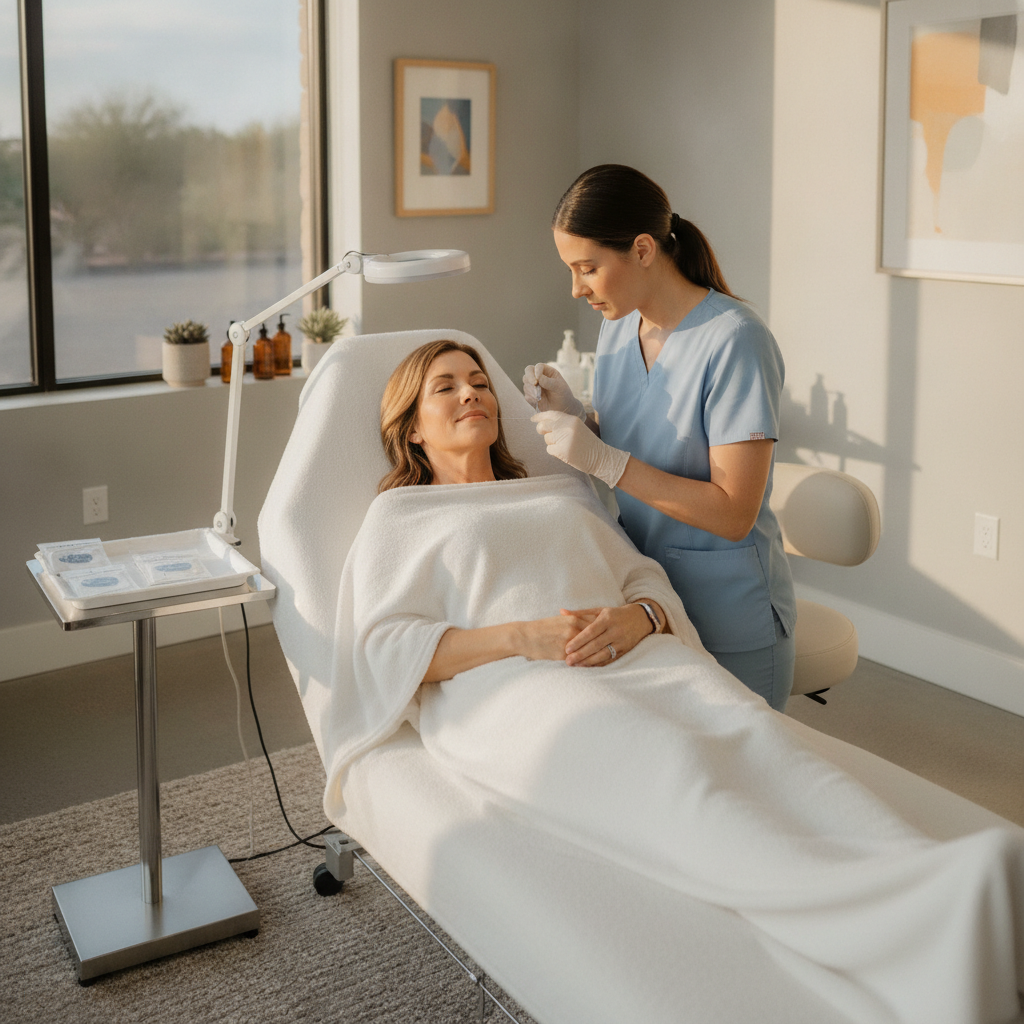
If you’ve noticed your jawline softening, your brows sitting a little lower, or that the skin along your cheeks isn’t quite where it used to be — you’re probably wondering what your options are short of surgery. PDO thread lifts are one of the most underused tools in non-surgical facial rejuvenation, and for the right candidate in Mesa or the surrounding East Valley, they can deliver a meaningful, natural-looking lift without a scalpel, general anesthesia, or weeks of downtime. Here’s what you actually need to know before booking a consultation.
What Exactly Are PDO Threads?
PDO stands for polydioxanone — a dissolvable suture material that’s been used safely in surgical settings for decades. In aesthetic medicine, very fine PDO threads are inserted under the skin using a thin needle or cannula to physically lift sagging tissue and simultaneously stimulate your body’s own collagen production in the treated area.
There are a few different types of threads, and a skilled provider will choose based on your anatomy and goals:
- Smooth threads — Used in a mesh pattern to improve skin texture and stimulate collagen. No lifting effect, but great for fine lines and crepey skin quality.
- Twist threads — Coiled threads that add volume and structure while encouraging collagen growth.
- Barbed (cog) threads — These have tiny hooks that grab and hold tissue, creating the actual lifting effect most people associate with a thread lift. These are what’s typically used for jawline definition, brow lifting, and jowl reduction.
The threads dissolve over several months, but the collagen response they trigger continues long after that — which is a big part of why results tend to develop and improve over time rather than peaking immediately.
What Can PDO Threads Actually Fix?
This is where it’s important to be honest rather than oversell. PDO threads work best for patients with mild to moderate skin laxity — not severe sagging that would genuinely require surgical correction. If you’re at the point where you’re losing definition but you’re not ready for (or interested in) a facelift, threads can be a genuinely effective middle-ground option.
Common areas treated with PDO threads include:
- The jawline and jowls — one of the most popular applications in East Valley patients
- Cheeks and midface — to restore a subtle lift and fullness without relying solely on filler
- Brows — a thread brow lift can open up the eye area noticeably
- Neck — for horizontal lines or early skin laxity along the neck
- Nasolabial folds and marionette lines — used alongside or instead of filler
One thing that often surprises people: threads and dermal fillers work exceptionally well together. Fillers restore volume; threads lift and reposition tissue. When used in combination by an experienced provider, the result tends to look more balanced and less “done” than relying on a single modality.
How Is a PDO Thread Lift Different From a Surgical Facelift?
This is the question most patients are really asking. Here’s a direct comparison:
- Downtime: A thread lift typically involves 3–7 days of mild swelling and bruising — nothing that requires you to disappear from your life. A surgical facelift generally means 2–4 weeks of visible recovery, plus additional healing time before you feel fully like yourself.
- Results: A surgical facelift delivers more dramatic correction and longer-lasting results (often 7–10 years). PDO threads offer a subtler lift that lasts roughly 1–2 years, after which many patients choose to repeat the treatment.
- Cost: Thread lifts are significantly less expensive than surgical facelifts. They’re also increasingly accessible through financing options — at Az Laser Studio & Medspa, we work with Cherry financing so cost doesn’t have to be a barrier to getting started.
- Risk profile: Both carry risks, but a non-surgical thread lift performed by a trained provider in a proper medspa setting carries far fewer risks than going under general anesthesia. That said, PDO threads are not a “no-risk” procedure — provider skill and sterile technique matter enormously.
For many patients in Mesa, Chandler, and Gilbert who are in their 40s or early 50s and experiencing early facial aging, a thread lift hits a practical sweet spot: real, visible improvement without the cost, risk, or recovery of surgery.
What Does the Procedure Actually Feel Like?
Most patients describe the experience as more pressure and odd sensation than actual pain. A topical numbing cream is applied beforehand, and some providers use a local anesthetic as well. The procedure itself typically takes 45–90 minutes depending on how many threads are placed and which areas are being treated.
Immediately after, you’ll likely look puffy and feel some tightness. Mild bruising and swelling are normal and usually resolve within a week. Your provider will give you specific aftercare instructions — things like avoiding aggressive facial movements, heavy exercise, and sleeping on your side for the first few days are standard recommendations.
Final results generally become more visible around 4–6 weeks as swelling fully resolves and collagen begins building. The full effect, including the longer-term collagen benefit, continues developing over several months.
Who Is — and Isn’t — a Good Candidate for PDO Threads?
A good candidate is someone with mild to moderate skin laxity, enough subcutaneous tissue for the threads to anchor into, and realistic expectations about the degree of lift achievable without surgery. If you’re in your late 30s to mid-50s and feeling like gravity is starting to win, you’re likely in the right zone for a thread consultation.
Threads are generally not the right choice if you have very thin, delicate skin, significant skin excess, or expectations better matched to surgical outcomes. A thorough consultation is essential — and any reputable provider will be straightforward with you if a different treatment or referral would serve you better.
It’s also worth noting that threads pair well with other in-office treatments. Many patients in the East Valley combine them with RF microneedling sessions to further improve skin quality and firmness alongside the structural lift from threads. Your provider can help sequence treatments appropriately based on your timeline and goals.
Why This Topic Gets Skipped — and Why That Matters for East Valley Patients
If you’ve been researching thread lifts in Mesa or Chandler and struggling to find detailed, practical information, you’re not imagining it. Most local medspa websites — including several competitors in the East Valley — either don’t mention PDO threads at all or cover them in a single vague sentence. That leaves a lot of patients either unaware that this option exists or unable to find enough information to make an informed decision.
The reality is that thread lifts fill a genuine gap in the aesthetic treatment ladder — somewhere between injectables and surgery — and they deserve a real, honest explanation. Living in the East Valley, where the combination of intense sun exposure and dry desert air can accelerate collagen loss and skin laxity over time, many patients find themselves considering these options earlier than they might in other climates. Having access to a provider who can clearly explain the options and help you choose wisely matters a lot.
Frequently Asked Questions About PDO Threads in Mesa
How long do PDO thread results last?
Most patients see results lasting 12–24 months. Because the collagen stimulation effect continues after the threads dissolve, the skin often maintains improved quality beyond the initial lift. Many patients choose to refresh treatment around the 18-month mark.
Does a thread lift hurt?
Discomfort is generally manageable. Topical numbing cream is applied before the procedure, and most patients describe a feeling of pressure or pulling rather than sharp pain. Some tenderness in the days following is normal.
Can PDO threads be combined with Botox or fillers?
Yes — and this is often the most effective approach. Neurotoxins like Botox or Dysport address dynamic wrinkles, fillers restore lost volume, and threads provide lift and structural support. Your provider will help you determine the right combination and timing for your goals.
How do I find a qualified PDO thread provider near me in Mesa or Chandler?
Look for a licensed NP or RN injector with documented training specifically in PDO thread placement, operating under physician oversight. PDO threads require a higher level of anatomical knowledge than standard injectables — provider credentials and experience matter more than price shopping here.
Is there anything I should avoid before a thread lift appointment?
Most providers recommend avoiding blood thinners (including aspirin, ibuprofen, fish oil, and alcohol) for several days before your appointment to minimize bruising. Your provider will give you a complete pre-care list at your consultation.
Ready to Find Out If PDO Threads Are Right for You?
At Az Laser Studio & Medspa in Mesa, our experienced medical team takes a consultation-first approach to every treatment — including PDO threads. We’ll look at your skin, talk through your goals, and give you an honest recommendation based on what’s actually going to get you the results you’re looking for. If threads are the right fit, we’ll explain exactly what to expect and how to make the most of your results. If a different treatment would serve you better, we’ll tell you that too.
Serving patients throughout Mesa, Chandler, Gilbert, Scottsdale, and the broader East Valley, we’re here to make sure you feel confident and informed before you ever sit in the treatment chair. Reach out today to schedule your free consultation — and get real answers to the questions you’ve been carrying around.